


Latest News
Artemis 3 Mission: NASA’s Historic Return to the Moon and the Future of Lunar Exploration


Short Overview
NASA’s Artemis 3 mission is one of the most exciting space exploration projects of the modern era. After more than five decades since the Apollo missions, NASA is preparing to land astronauts on the Moon again with advanced technology, modern spacecraft, and ambitious scientific goals. The Artemis 3 mission is not only about returning humans to the lunar surface, but also about building the foundation for future Mars missions and long-term human presence in deep space. With the help of SpaceX’s Starship Human Landing System and the Orion spacecraft, NASA aims to create a new chapter in human space exploration that could redefine the future of humanity beyond Earth.
NASA’s Artemis 3 mission is preparing to return astronauts to the Moon for the first time in over 50 years. Discover the latest mission details, astronaut training, SpaceX lunar landing system, mission goals, Moon exploration technology, scientific objectives, and how Artemis 3 could shape the future of human space exploration and Mars missions. Learn everything about NASA’s ambitious lunar program in this complete guide.

Table of Contents
- Introduction to Artemis 3
- Why Artemis 3 Is Important
- NASA’s New Details About the Artemis 3 Mission
- The Main Goals of Artemis 3
- How Artemis 3 Differs From Apollo Missions
- The Orion Spacecraft and Lunar Gateway
- SpaceX Starship’s Role in Artemis 3
- Astronaut Training and Mission Preparation
- Scientific Experiments Planned on the Moon
- Challenges NASA Faces Before Launch
- Artemis 3 and the Future of Mars Exploration
- Global Interest in Lunar Exploration
- Economic and Technological Impact of Artemis 3
- Public Excitement and Media Attention
- Why Artemis 3 Could Change Human History
- Conclusion
Introduction to Artemis 3
The Artemis 3 mission represents one of the biggest milestones in modern space exploration. NASA is preparing to send astronauts back to the Moon for the first time since Apollo 17 in 1972. This mission is part of NASA’s larger Artemis program, which aims to establish a sustainable human presence on the Moon and eventually prepare humanity for missions to Mars.
Unlike earlier lunar missions, Artemis 3 is being designed with long-term exploration in mind. NASA wants to use the Moon as a testing ground for advanced technologies, deep-space operations, and human survival systems that will later support future Mars expeditions.
The excitement around Artemis 3 continues to grow because this mission is not only about science. It is also about innovation, international collaboration, and inspiring a new generation of explorers, scientists, and engineers.
Why Artemis 3 Is Important
Artemis 3 is far more than a symbolic return to the Moon. NASA considers it a critical step toward long-duration space exploration. The mission will help researchers better understand how humans can live and work on another world for extended periods.
One of the most historic aspects of Artemis 3 is that NASA plans to land the first woman and the first person of color on the Moon. This reflects a new era of diversity and inclusion in space exploration.

The mission also carries geopolitical importance. Several countries, including China and Russia, are increasing their lunar ambitions. NASA’s Artemis program demonstrates the United States’ commitment to maintaining leadership in space exploration while also encouraging peaceful international cooperation.
Another major reason Artemis 3 matters is the scientific opportunity. The Moon’s south pole contains water ice deposits that could support future human settlements. These resources could eventually be used to create drinking water, breathable oxygen, and rocket fuel.
NASA’s New Details About the Artemis 3 Mission
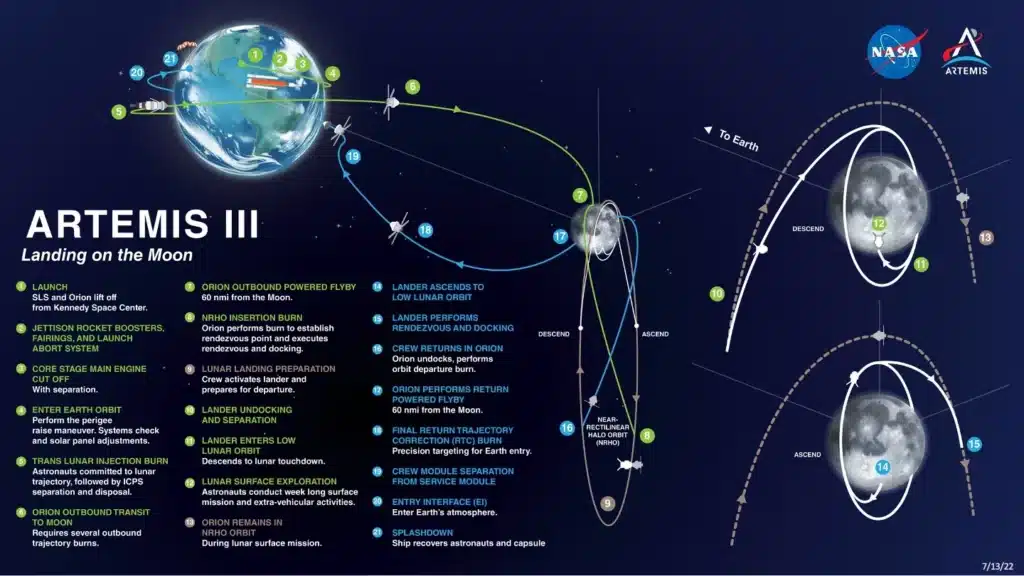
NASA recently shared new information regarding the Artemis 3 mission timeline, mission architecture, astronaut operations, and lunar landing strategy. According to the latest updates, astronauts will travel aboard the Orion spacecraft using NASA’s powerful Space Launch System rocket.
After reaching lunar orbit, the crew will transfer to SpaceX’s Starship Human Landing System. This advanced spacecraft will transport astronauts to the Moon’s surface near the lunar south pole.
NASA revealed that the astronauts are expected to spend more time on the lunar surface compared to Apollo astronauts. During their stay, they will conduct scientific research, collect samples, and test advanced exploration technologies.
The agency also highlighted ongoing improvements in spacesuit technology. Artemis astronauts will use next-generation lunar suits designed for better flexibility, mobility, and protection against harsh lunar conditions.
These updated mission details show how NASA is combining innovation, safety, and scientific ambition to make Artemis 3 one of the most advanced human space missions ever attempted.
The Main Goals of Artemis 3
NASA has several important objectives for Artemis 3. The first major goal is safely landing astronauts on the Moon and returning them to Earth successfully.
Another key goal involves exploring the lunar south pole, which scientists believe contains valuable water ice reserves. Understanding these resources could support future Moon bases and long-term exploration.
NASA also wants to study how humans interact with the lunar environment over extended periods. This includes understanding radiation exposure, lunar dust effects, and psychological challenges of deep-space missions.
The mission will also test new technologies that could later be used for Mars exploration. Systems for navigation, communication, energy production, and habitat construction will play critical roles in future missions beyond the Moon.
Most importantly, Artemis 3 is designed to establish the beginning of sustainable lunar exploration instead of short-term visits.
How Artemis 3 Differs From Apollo Missions
Although Artemis 3 shares similarities with the Apollo missions, it represents a completely different era of space exploration.
The Apollo program focused primarily on demonstrating that humans could land on the Moon and return safely. Artemis, however, focuses on long-term exploration and sustainability.
Modern technology gives Artemis 3 enormous advantages. Advanced computers, artificial intelligence, modern navigation systems, and powerful spacecraft make the mission more capable than anything available during the Apollo era.
The Artemis astronauts will also spend more time conducting scientific experiments and exploring the lunar environment in greater detail.
Another major difference is international collaboration. NASA is working with global space agencies and private companies like SpaceX to make Artemis missions possible.
This partnership-driven approach reflects how modern space exploration is evolving into a global effort.
The Orion Spacecraft and Lunar Gateway
The Orion spacecraft is a critical part of the Artemis program. Designed for deep-space missions, Orion can support astronauts during long journeys beyond Earth orbit.
The spacecraft includes advanced life-support systems, radiation protection, and high-speed reentry capabilities. NASA spent years testing Orion to ensure astronaut safety during missions far from Earth.
Another important component of the Artemis program is the Lunar Gateway, a small space station planned for lunar orbit. Although Artemis 3 may not fully depend on Gateway, future missions will use it as a staging point for lunar operations.
Gateway could eventually serve as a hub for scientific research, astronaut accommodation, and mission preparation for deeper space travel.
SpaceX Starship’s Role in Artemis 3
One of the most talked-about aspects of Artemis 3 is the involvement of SpaceX’s Starship Human Landing System.
NASA selected SpaceX to develop the lunar lander because of the company’s innovative reusable rocket technology. Starship is expected to transport astronauts from lunar orbit to the Moon’s surface and back.
The spacecraft is significantly larger and more advanced than previous lunar landers. It is designed to carry larger payloads, more scientific equipment, and potentially support longer missions.
SpaceX’s role in Artemis 3 also represents a major shift in how space agencies collaborate with private companies. Commercial space partnerships are becoming increasingly important in reducing costs and accelerating technological innovation.
Many experts believe Artemis 3 could mark the beginning of a new commercial space era.
Astronaut Training and Mission Preparation
Preparing astronauts for Artemis 3 requires years of intense training.
NASA astronauts undergo simulations that replicate lunar gravity, emergency scenarios, and long-duration isolation. They practice operating spacecraft systems, conducting moonwalks, and performing scientific experiments.
Training also includes geological field studies because astronauts will collect lunar rock samples during the mission. Scientists want crew members to identify valuable materials and understand lunar terrain conditions.
Physical fitness remains another critical focus. Space missions place enormous stress on the human body, especially during launch, landing, and extended exposure to microgravity.
NASA is also training astronauts to work with advanced robotic systems and autonomous technologies that may support future lunar operations.
Scientific Experiments Planned on the Moon
Scientific research is one of the core purposes of Artemis 3.
Astronauts will study lunar geology to better understand the Moon’s history and evolution. Researchers hope the collected samples may reveal information about the early solar system.
Another important area of study involves water ice near the lunar south pole. Scientists want to determine how accessible these resources are and whether they can support future missions.
NASA also plans to test new equipment designed for long-term lunar exploration. This includes advanced communication systems, power technologies, and surface mobility tools.
The mission could provide valuable insights into how humans might survive on other planets in the future.
Challenges NASA Faces Before Launch
Despite its enormous potential, Artemis 3 faces several major challenges.
Technical delays remain one of the biggest concerns. Developing advanced spacecraft systems, lunar landers, and astronaut suits requires extensive testing and engineering work.
Safety is another critical issue. Deep-space missions involve risks such as radiation exposure, equipment failure, and communication delays.
Budget pressures also affect mission timelines. Space exploration projects often require billions of dollars and long-term government support.
Additionally, coordinating multiple contractors and international partners adds complexity to mission planning.
Even with these obstacles, NASA continues making progress toward launching one of the most ambitious space missions ever attempted.
Artemis 3 and the Future of Mars Exploration
NASA sees Artemis 3 as a stepping stone toward Mars.
The Moon offers an ideal environment for testing technologies needed for deep-space travel. Lessons learned during lunar missions will help scientists prepare for the challenges of sending humans to Mars.
Long-duration habitats, life-support systems, radiation shielding, and resource utilization technologies can all be tested on the Moon before attempting interplanetary missions.
Many experts believe successful Artemis missions could accelerate human Mars exploration within the next few decades.
The knowledge gained from Artemis 3 may eventually help humanity become a multi-planetary species.
Global Interest in Lunar Exploration
Interest in lunar exploration is growing rapidly around the world.
Countries such as China, India, Japan, and members of the European Space Agency are all investing heavily in Moon missions.
This global competition and collaboration are driving innovation in aerospace technology. Lunar exploration is becoming one of the most important scientific and strategic priorities of the 21st century.
Private companies are also entering the space industry at an unprecedented rate. Commercial lunar missions, satellite services, and resource exploration projects could eventually create a massive space economy.
Artemis 3 sits at the center of this rapidly evolving space race.
Economic and Technological Impact of Artemis 3
The Artemis program is expected to generate enormous economic benefits.
Space exploration often leads to breakthroughs in engineering, communication, medicine, robotics, and materials science. Many technologies originally developed for space missions later become useful in everyday life.
NASA’s partnerships with private companies are also creating thousands of high-skilled jobs across the aerospace sector.
The mission is inspiring investments in advanced manufacturing, artificial intelligence, renewable energy systems, and autonomous robotics.
Some analysts believe the future lunar economy could eventually include mining operations, research facilities, and even tourism.
Public Excitement and Media Attention
Public interest in Artemis 3 continues to rise as NASA reveals more mission details.
Social media platforms, news outlets, and science communities are actively discussing the mission’s potential impact. The idea of humans returning to the Moon after more than 50 years captures global imagination.
Young students are especially inspired by the Artemis program. NASA hopes these missions will encourage future generations to pursue careers in science, engineering, and technology.
The combination of advanced spacecraft, historic astronaut milestones, and ambitious scientific goals makes Artemis 3 one of the most anticipated missions in modern history.
Why Artemis 3 Could Change Human History
Artemis 3 represents more than another space mission. It symbolizes humanity’s desire to explore beyond known boundaries.
If successful, the mission could reshape how humans view space exploration and our future in the universe. Establishing a sustainable presence on the Moon would open opportunities for scientific discovery, commercial development, and international cooperation.
The technologies developed for Artemis 3 may eventually support missions to Mars and beyond. Future generations could look back at Artemis 3 as the beginning of humanity’s expansion into deep space.
Few missions in history have carried such enormous scientific, technological, and cultural significance.
Conclusion
NASA’s Artemis 3 mission is preparing to usher humanity into a new era of lunar exploration. With advanced spacecraft, modern astronaut training, innovative lunar technologies, and ambitious scientific objectives, this mission could become one of the defining achievements of the 21st century.
Unlike previous Moon missions, Artemis 3 focuses on sustainability, long-term exploration, and preparation for future Mars missions. The collaboration between NASA, private aerospace companies, and international partners reflects how space exploration is evolving into a truly global effort.
As excitement continues to build, Artemis 3 reminds the world that exploration remains one of humanity’s greatest strengths. The mission is not only about returning to the Moon. It is about building the future of human civilization beyond Earth.


NEET UG Re-Exam 2026: Why Telegram Was Restricted in India and What It Means for Students

Spotify Outage 2026: Thousands of Users Report Streaming Issues Across the Globe

Stock Market Today: Sensex, Nifty & Top Stocks in Focus Amid Global Market Uncertainty

NEET Re-Exam Admit Card 2026 Released: Direct Download Link, Exam Day Guidelines & Important Updates

Made-in-India C295 Aircraft Maiden Flight Marks a New Chapter in India’s Defence Manufacturing

Higher Ethanol Blended Petrol Gets Excise Duty Exemption: What It Means for India’s Fuel Future

What I Eat In A Day As An Indian Diabetic To Lose Weight

10 Simple Indian Home Habits That Help You Lose Weight With Type 2 Diabetes

Diabetes-Friendly Indian Breakfasts That Melt Belly Fat and Control Blood Sugar Naturally

Mango Weight Gain Myth: Smart Ways to Enjoy Mangoes Without Gaining Weight This Summer

11 Foods That Help Reduce Belly Fat Naturally and Support Healthy Weight Loss
Mango Weight Gain Myth: Smart Ways to Enjoy Mangoes Without Gaining Weight This Summer
Diabetes-Friendly Indian Breakfasts That Melt Belly Fat and Control Blood Sugar Naturally

Brain Tumor Warning Signs: When a Headache Is More Than Just a Headache

Blood Pressure Test Tips: Why Avoiding Tea Before Your BP Check Matters
Higher Ethanol Blended Petrol Gets Excise Duty Exemption: What It Means for India’s Fuel Future
10 Simple Indian Home Habits That Help You Lose Weight With Type 2 Diabetes
What I Eat In A Day As An Indian Diabetic To Lose Weight
Spotify Outage 2026: Thousands of Users Report Streaming Issues Across the Globe