


Latest News
NASA Psyche Spacecraft Captures Stunning Crescent View of Mars Before Historic Flyby


Short Overview
NASA’s Psyche spacecraft has once again captured global attention after sending back a breathtaking crescent image of Mars just days before its highly anticipated flyby. The rare image offers a haunting yet beautiful glimpse of the Red Planet from deep space while showcasing the advanced capabilities of NASA’s ambitious Psyche mission. Scientists believe this mission could transform our understanding of planetary formation, metallic asteroids, and the origins of our solar system. The latest visuals from the spacecraft are not only visually mesmerizing but also scientifically valuable, giving researchers fresh insights into space navigation and interplanetary exploration.
Discover how NASA’s Psyche spacecraft captured a haunting crescent image of Mars before its dramatic May 15 flyby. Explore the mission goals, deep space technology, asteroid Psyche discoveries, Mars observations, and why this breakthrough matters for future space exploration and scientific research across the solar system

Table of Contents
- Introduction to NASA’s Psyche Mission
- The Incredible Crescent View of Mars
- Why the Mars Flyby Matters
- What is the Psyche Asteroid?
- How the Psyche Spacecraft Captured the Image
- Scientific Importance of the Flyby
- Advanced Technology Behind the Mission
- What Scientists Hope to Discover
- Public Reaction to the Stunning Mars Image
- The Future of Deep Space Exploration
- How Psyche Could Change Our Understanding of Planets
- NASA’s Growing Focus on Asteroid Missions
- Challenges Faced During the Mission
- Why This Mission Matters for Humanity
- Conclusion
Introduction to NASA’s Psyche Mission
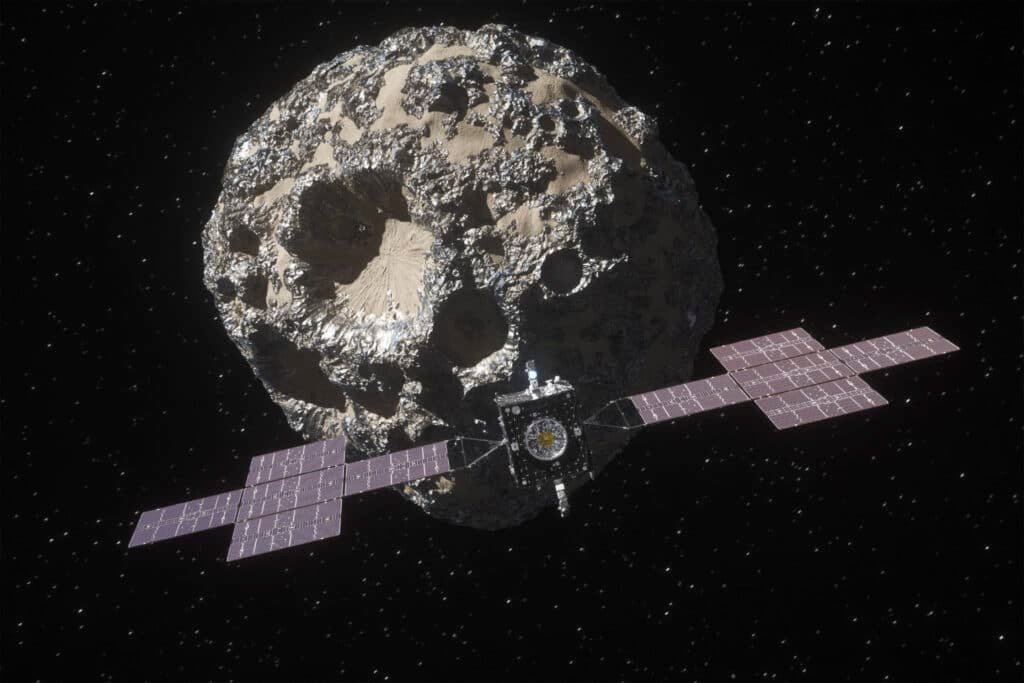
NASA’s Psyche mission is one of the most fascinating space exploration projects of the modern era. Unlike many previous missions that focused on planets or moons, this mission is aimed at studying a unique metal-rich asteroid called Psyche, located in the asteroid belt between Mars and Jupiter. Scientists believe this asteroid may actually be the exposed core of an ancient planet that never fully formed.
The spacecraft was launched to uncover secrets hidden deep within our solar system. By studying Psyche, researchers hope to learn how rocky planets like Earth were created billions of years ago. The mission represents a major step toward understanding planetary evolution and the building blocks of our cosmic neighborhood.
Recently, the mission gained massive public attention after NASA released a haunting crescent image of Mars captured by the spacecraft before its scheduled flyby. The image immediately sparked excitement among astronomers, scientists, and space enthusiasts around the world.
The Incredible Crescent View of Mars
The newly released image of Mars is unlike the typical photographs people are used to seeing. Instead of showing the entire planet brightly illuminated, the spacecraft captured Mars in a delicate crescent phase, creating a mysterious and dramatic appearance.
The dark emptiness surrounding the glowing edge of Mars gives the image an almost cinematic quality. Many people online described it as haunting, surreal, and breathtaking. The photograph highlights just how vast and lonely space truly is while reminding humanity how small our world appears in the grand universe.
This image is more than just visually beautiful. It also demonstrates the incredible precision and imaging capability of the Psyche spacecraft. Capturing such a detailed view from millions of kilometers away requires highly advanced navigation systems and powerful onboard instruments.
NASA scientists explained that the image was taken during the spacecraft’s journey toward its gravity-assist flyby around Mars. This maneuver is a critical part of the mission because it helps the spacecraft gain additional speed without using excessive fuel.

Why the Mars Flyby Matters
The May 15 Mars flyby is not simply a sightseeing moment in space. It is a carefully planned scientific and navigational event that plays a major role in the mission’s long-term success.
Gravity-assist flybys are commonly used in deep space exploration. During the maneuver, the spacecraft uses the gravitational pull of a planet to alter its trajectory and increase speed. This technique allows missions to travel farther while conserving fuel and reducing mission costs.
For the Psyche spacecraft, Mars acts almost like a cosmic slingshot. As the spacecraft passes close to the planet, Mars’ gravity will help redirect it toward the asteroid belt where the Psyche asteroid is located.
This flyby also gives NASA a valuable opportunity to test instruments, collect data, and refine navigation systems. Every successful maneuver strengthens confidence in future deep-space missions.
What is the Psyche Asteroid?
The Psyche asteroid is one of the most unusual objects in our solar system. Unlike most asteroids that are primarily made of rock or ice, Psyche appears to contain massive amounts of metal, including iron and nickel.
Scientists estimate that the asteroid could be the remains of an ancient planetary core that lost its outer layers due to violent collisions billions of years ago. If this theory is correct, studying Psyche could provide a rare opportunity to examine the interior of a planet without drilling through thousands of kilometers of rock.
The asteroid measures around 226 kilometers in diameter and is located in the asteroid belt between Mars and Jupiter. Because of its metallic composition, Psyche has fascinated astronomers for decades.
Some reports even estimated the asteroid’s theoretical material value to be unimaginably high, although the mission is purely scientific and not related to mining or commercial activity.
How the Psyche Spacecraft Captured the Image
Capturing the crescent image of Mars required an extraordinary combination of engineering, timing, and precision. The spacecraft used advanced imaging systems designed to function in the harsh conditions of deep space.
The cameras onboard the spacecraft are capable of handling extreme distances, low light conditions, and rapid motion. NASA engineers carefully coordinated the imaging process during the spacecraft’s approach toward Mars.
Even slight errors in positioning could have resulted in blurred or unusable images. The successful capture demonstrates the reliability of the spacecraft’s instruments and the expertise of the mission team.
The image processing team also played an important role in refining the final photograph. They adjusted brightness levels, contrast, and data clarity to produce the striking image released to the public.
Scientific Importance of the Flyby
The Mars flyby is not only important for navigation but also for science. During the close approach, the spacecraft can collect valuable information about Mars and the surrounding space environment.
Researchers can use this opportunity to test communication systems, analyze radiation conditions, and observe planetary dynamics from a unique perspective. These observations contribute to broader scientific understanding and improve preparation for future interplanetary missions.
The event also helps scientists better understand how spacecraft behave during high-speed planetary encounters. This knowledge can be useful for future missions to distant planets, moons, and asteroids.
Advanced Technology Behind the Mission
One reason the Psyche mission stands out is the advanced technology packed into the spacecraft. NASA equipped the mission with several cutting-edge systems designed for long-duration deep-space travel.
One of the most exciting features is the Deep Space Optical Communications experiment. This technology uses lasers instead of traditional radio signals to transmit information across space. Laser communication could dramatically improve data transfer speeds for future missions.
The spacecraft also uses solar electric propulsion, which is more fuel-efficient than conventional chemical rockets. Large solar panels generate electricity that powers ion thrusters, allowing the spacecraft to travel enormous distances over time.
These innovations represent the future of space exploration. If successful, they could influence how humanity explores the Moon, Mars, and beyond.
What Scientists Hope to Discover
Scientists believe the Psyche mission could answer some of the biggest questions about planetary formation. By studying the asteroid’s composition, magnetic properties, and surface structure, researchers hope to understand how planetary cores evolve.
The mission may reveal whether Psyche truly is the exposed core of a failed planet. If confirmed, it would provide direct evidence about the violent processes that shaped the early solar system.
Researchers are especially interested in understanding how metal-rich bodies formed and how they differ from rocky planets and icy objects. These discoveries could reshape current scientific theories about planetary development.
The mission may also uncover clues about Earth’s own metallic core, which remains inaccessible beneath thousands of kilometers of rock.
Public Reaction to the Stunning Mars Image
The crescent image of Mars quickly went viral across social media platforms and science communities. Millions of people were captivated by the unusual perspective of the Red Planet.
Many viewers described the image as emotional because it highlights the beauty and isolation of space. Others praised NASA for continuing to inspire public interest in science and exploration.
Space photography has always had the power to connect people with the universe. Images like this remind humanity that exploration is not only about technology and data but also about curiosity, imagination, and wonder.
The photograph also generated increased attention toward the Psyche mission itself, helping more people learn about the importance of asteroid exploration.
The Future of Deep Space Exploration
The Psyche mission represents a larger shift in NASA’s long-term exploration strategy. Space agencies are increasingly focusing on missions that can uncover the origins of planets, water, and life itself.
Asteroids are considered time capsules from the early solar system because many have remained relatively unchanged for billions of years. By studying them, scientists can gather information about the materials that existed when planets first formed.
Future missions may build upon the technologies and lessons learned from Psyche. Improved propulsion systems, laser communications, and autonomous navigation could make deep-space travel more efficient and reliable.
This mission also supports future ambitions for human exploration of Mars and beyond.
How Psyche Could Change Our Understanding of Planets
Most people imagine planets as giant spheres covered in rock, oceans, or gas. However, the Psyche asteroid challenges traditional assumptions about planetary structures.
If Psyche is indeed an exposed planetary core, it offers scientists a rare natural laboratory to study the hidden interior of a world. Normally, planetary cores are impossible to observe directly because they are buried deep beneath thick crusts and mantles.
Studying Psyche could reveal how magnetic fields form, how planetary interiors cool over time, and how collisions shaped the early solar system.
The mission may even help researchers understand why some planets survived while others were destroyed during the chaotic formation of the solar system.
NASA’s Growing Focus on Asteroid Missions
Over the last decade, NASA has significantly expanded its asteroid research programs. Missions such as OSIRIS-REx and DART have demonstrated the growing importance of studying near-Earth objects and distant asteroids.
Asteroids are scientifically valuable because they preserve ancient materials from the birth of the solar system. Some also pose potential impact risks to Earth, making asteroid research important for planetary defense.
The Psyche mission fits perfectly into this broader strategy. By exploring a metal-rich asteroid, NASA is opening a completely new chapter in planetary science.
The knowledge gained could influence future missions focused on asteroid mining, resource extraction, and long-duration space travel.
Challenges Faced During the Mission
Deep-space missions are incredibly difficult and expensive. Every stage of the Psyche mission requires careful planning and precision.
The spacecraft must survive extreme temperatures, radiation exposure, communication delays, and long travel distances. Engineers also need to ensure that all onboard systems continue functioning properly over many years.
Even small navigation errors could potentially place the mission at risk. This is why the Mars flyby is such a critical milestone.
NASA teams constantly monitor the spacecraft and make adjustments when necessary. Their work demonstrates the extraordinary level of expertise required for modern space exploration.
Why This Mission Matters for Humanity
The Psyche mission is about far more than a single asteroid or one spectacular photograph. It represents humanity’s ongoing desire to understand where we came from and what exists beyond our world.
Space exploration pushes technological boundaries and inspires future generations to pursue science, engineering, and discovery. Missions like Psyche remind people that curiosity is one of humanity’s greatest strengths.
The haunting crescent image of Mars symbolizes this spirit perfectly. It captures a moment of exploration that combines science, beauty, and ambition in a way few images can.
As the spacecraft continues its journey, millions of people around the world will be watching closely, eager to see what new discoveries await.
Conclusion
NASA’s Psyche spacecraft has already achieved something remarkable by capturing a stunning crescent view of Mars before its dramatic flyby. The image is not only visually unforgettable but also scientifically meaningful, representing a major milestone in one of NASA’s most ambitious asteroid missions.
As the spacecraft travels deeper into the solar system, scientists hope it will unlock secrets about planetary cores, asteroid composition, and the origins of worlds like Earth. The mission combines cutting-edge technology, bold scientific goals, and humanity’s endless curiosity about the universe.
The Psyche mission proves that space exploration continues to inspire people across the globe. Every image, discovery, and milestone reminds us that there is still so much left to learn beyond our planet. With each new step into deep space, humanity moves closer to understanding the mysteries of the cosmos.


NEET UG Re-Exam 2026: Why Telegram Was Restricted in India and What It Means for Students

Spotify Outage 2026: Thousands of Users Report Streaming Issues Across the Globe

Stock Market Today: Sensex, Nifty & Top Stocks in Focus Amid Global Market Uncertainty

NEET Re-Exam Admit Card 2026 Released: Direct Download Link, Exam Day Guidelines & Important Updates

Made-in-India C295 Aircraft Maiden Flight Marks a New Chapter in India’s Defence Manufacturing

Higher Ethanol Blended Petrol Gets Excise Duty Exemption: What It Means for India’s Fuel Future

What I Eat In A Day As An Indian Diabetic To Lose Weight

10 Simple Indian Home Habits That Help You Lose Weight With Type 2 Diabetes

Diabetes-Friendly Indian Breakfasts That Melt Belly Fat and Control Blood Sugar Naturally

Mango Weight Gain Myth: Smart Ways to Enjoy Mangoes Without Gaining Weight This Summer

AI Cyber Attacks in India: What CERT-In’s New Cybersecurity Guidelines Mean for Businesses

Pension ULIP: Why the 10x Growth in FY26 Shows India Is Getting Serious About Retirement Planning

New Tata Tiago Facelift Launched At Rs 4.69 Lakh, Here’s Your COMPLETE Look At Every Detail And Pricing

11 Foods That Help Reduce Belly Fat Naturally and Support Healthy Weight Loss
Mango Weight Gain Myth: Smart Ways to Enjoy Mangoes Without Gaining Weight This Summer
Diabetes-Friendly Indian Breakfasts That Melt Belly Fat and Control Blood Sugar Naturally

Coconut Water Daily in Summer: What Happens When You Drink It for 15 Days?

Brain Tumor Warning Signs: When a Headache Is More Than Just a Headache

Blood Pressure Test Tips: Why Avoiding Tea Before Your BP Check Matters