

Short overview
Indian Farmers and Government Schemes are very important for Indian farmers as these schemes provide financial support, crop insurance, agricultural loans, subsidies and other farming benefits to farmers. But there are still many farmers who find it difficult to understand the application procedures, complete online registrations and submit the required documents.
A Common Service Center (CSC) also called Jan Seva Kendra is a local digital service center that facilitates farmers to avail various government services. Farmers can get help for registration of eligible schemes, Aadhaar based e-KYC, submission of applications and status checking.
This guide will guide the farmers on how to apply for the government schemes through the CSC Jan Seva Kendra, what documents can be required and how to avoid the common mistakes while applying.
Introduction Farmer Government Schemes in Indian
Agriculture is one of the most important sectors of the economy of India. Farming is the livelihood of millions of families. But farmers face constant challenges such as escalating costs of cultivation, unpredictable weather, crop losses, expensive farm equipment and limited access to financial support.
The Indian government has a number of agricultural welfare schemes to empower the farming community. These schemes provide financial assistance, crop insurance, agricultural loans, pension benefits and subsidies for farming related activities.
Many benefits are available but some farmers are finding it difficult to apply because they are not familiar with online registration, digital documents and government websites.
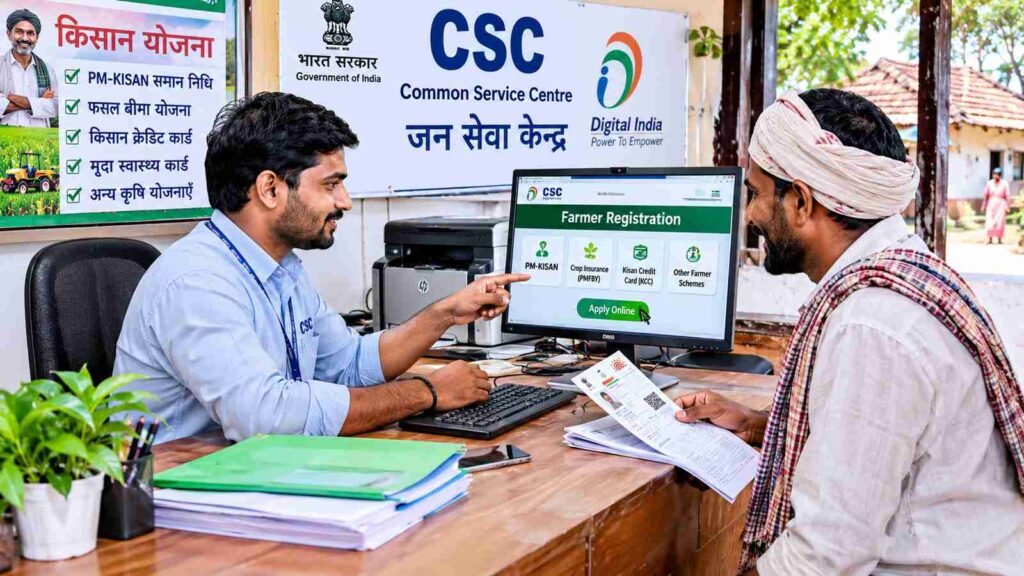
This is where the utility of the Common Service Center (CSC), popularly known as Jan Seva Kendra comes in. These centers help farmers to avail digital government services, without having to handle every online procedure themselves.
Eligible farmers can apply for some government schemes, complete the verification process and check the status of their applications with the help of a CSC operator.
What is Jan Seva Kendra CSC?
Common Service Centers are a government-backed access point for digital services, established under India’s Digital India initiative. It lets people in rural and remote areas access online government and public services.
These centers are operated by Village Level Entrepreneurs (VLEs) who help citizens with a variety of digital services.
CSC Jan Seva Kendras can assist farmers with services like PM-KISAN registration, Aadhaar based e-KYC, select agriculture scheme applications, insurance related services and digital documentation.
The main purpose of these centers is to facilitate access to government services, especially for those who do not own computers, have stable internet connections or the necessary knowledge of digital technologies.
Farmers don’t need to visit different government offices for basic digital help, they can visit a nearby CSC and receive guidance on the services they can avail.
Why CSC Centers are important for Indian Farmers?
Digital government services have made it easier to access many agricultural schemes. But not all farmers are comfortable with using smart phones, online portals and digital application forms.
This problem is alleviated by the support of local CSC centers.
For instance, a farmer who wants to register for PM-KISAN might require assistance with Aadhaar entry, verification of registration details and e-KYC. The CSC operator can guide the farmer through the available process.
These centers are also helpful for farmers who want to understand the application requirements for agricultural loans, insurance and other welfare programs.
Another important benefit is that, if the service provides it, farmers can get acknowledgments of application or reference numbers to track their submissions.
However, a visit to a CSC does not automatically mean approval. Applications are approved and eligibility checked by the relevant government department, bank or insurance authority.
CSCs become a gateway for farmers to avail popular government schemes
PM Kisan Samman Nidhi Yojana
Pradhan Mantri Kisan Samman Nidhi (PM-KISAN) is one of the important farmer welfare programs of India.
The scheme provides financial assistance of Rs 6,000 per year to eligible landholding farmer families. The Direct Benefit Transfer (DBT) is being made in three equal instalments directly in the bank accounts of the eligible beneficiaries.
This assistance can be utilized by farmers to support agricultural expenses, purchase seeds, buy fertilizers and manage other farming needs.
Farmers can get help at a CSC for new registration and mandatory e-KYC processes. They can also check the beneficiary details and status of the application through the official PM-KISAN portal.
Farmers should check their details before applying as eligibility conditions and exclusion rules apply.
Kisan Credit Card (KCC) Scheme:
Kisan Credit Card scheme provides institutional credit to farmers for agriculture and allied activities.
Under the applicable lending conditions, KCC will assist eligible farmers to obtain credit for crop cultivation, agriculture inputs and some allied activities of farming.
Farmers looking for financial help for seeds, fertilizers, pesticides and other cultivation expenses can check out this facility.
In areas where the service is available, the CSC centers can help farmers to complete and submit KCC applications digitally. The application is sent to the concerned bank for scrutiny.
Farmers should keep their land records, crop details and bank details ready before applying.
Pradhan Mantri Fasal Bima Yojana (PMFBY)
Crop failure could spell serious financial trouble for the farmers. Natural disasters, drought, floods, pests and diseases can wipe out agricultural production.
The Pradhan Mantri Fasal Bima Yojana offers crop insurance coverage to eligible farmers against identified crop losses insured under the scheme.
Depending upon the notified season and state, farmers can explore enrollment through authorized CSC facilities, insurance intermediaries, banks and other permitted channels.
Farmers need to verify the notified crops, insurance company, enrollment deadline and applicable premium in their location before applying.
Remember, the crop insurance coverage is subject to scheme conditions and the nature of the loss reported.
Pradhan Mantri Kisan Maandhan Yojana (PM-KMY)
Pradhan Mantri Kisan Maandhan Yojana is a voluntary pension scheme for eligible small and marginal farmers.
Under the scheme, eligible farmers contribute monthly based on their age at the time of enrollment. The government makes a matching contribution.
As per the conditions of the scheme, eligible subscribers will receive a monthly pension of Rs 3,000 on attaining the age of 60 years.
CSC centers are important channel for registration for the eligible farmers. The applicants are usually required to possess an Aadhaar card, bank account details and a mobile number.
This program can help eligible farmers plan for financial security in their later years.
Agricultural Subsidy and Equipment Program
The government also provides support to the farmers through various agriculture development programs.
Depending upon the state and scheme, farmers can get financial assistance for farm machinery, irrigation equipment, solar pumps, micro irrigation systems, protected cultivation and other agriculture improvements.
For example, eligible farmers may seek support under agricultural mechanization programs and PM-KUSUM for solar-powered agricultural solutions.
However, the availability of subsidies, application processes and eligibility criteria vary from state to state and program to program.
Farmers can also contact the nearest CSC or agriculture department office to know about the schemes running in their district.
How to Apply Government Schemes in CSC Jan Seva Kendra
It’s pretty easy to get through a CSC in general. But the exact procedure depends on the particular government scheme.
Step 1: Locate your nearest CSC Center
First, find a Common Service Center near you which is authorized. Farmers can check the available centers on the official CSC portal.
Select a center which offers the service you require. Not every agricultural scheme or service is available at every CSC.
Step 2: Know the Scheme Eligibility
Before starting the application, ask the CSC operator about the eligibility conditions of the scheme.
For example, PM-KISAN has landholding and exclusion criteria and Kisan Credit Card applications are assessed by lending institutions.
Knowing in advance the requirements can help avoid unnecessary mistakes in the application.
Step 3: Gather the necessary documents
Keep your Aadhaar card, bank passbook, mobile number and relevant agricultural land papers at hand.
Some schemes may also require other documents like crop details, photographs, income details or other state specific certificates.
Step 4: Fill out the Online Application
The CSC operator will guide you to the relevant government portal or authorized application system.
Make sure you enter your name, Aadhaar details, address, bank info and other important details correctly.
Always check the information before you give your consent and submit the application.
Step 5: Complete Aadhaar e-KYC if necessary
Some agricultural schemes have Aadhaar-based identity verification.
Depending on the scheme, e-KYC can be done through OTP, biometric or face authentication.
For PM-KISAN, the beneficiaries need to complete e-KYC. Farmers unable to complete OTP verification can get biometric assistance through an authorized CSC.
Step 6: Obtain the Application Reference Number
If you submit successfully, ask for an acknowledgment or application reference number where possible.
Please keep this information safe, because you might need it to check the status of the application or to solve problems later.
Step 7: Check the Status of Your Application
Farmers are advised to check the application status time to time through concerned official portal or authorized service center.
Other applications may need additional verification from state departments, banks or other authorities.
If an application is pending or rejected ask for the reason and follow the official correction or grievance procedure.
Required Documents for Farmer Government Scheme Registration

The required documents vary as per the government scheme and the farmer’s eligibility category.
Farmers should be ready with their Aadhaar card, active mobile number, bank passbook, land ownership records and recent photographs.
For crop insurance, crop details and cultivation details may be required. For Kisan Credit Card applications, banks may seek land records, details of crops grown and other financial information.
Some subsidy programs at the state level may require caste certificates, income certificates, quotations of agricultural equipment or other supporting documents.
It is always advisable to check the exact documents required before going to the CSC center.
Advantages of applying at a CSC Jan Seva Kendra:
One of the major benefits of the CSC centers is their convenience. Farmers from the village can now access a select set of digital services locally, instead of traveling long distances to government offices.
The centers also assist those who are not accustomed to applying online. A trained operator can explain the registration process and help you upload documents.
Another benefit is availability of Aadhaar based verification services, submission of applications in digital format and other citizen services at the authorized centers.
CSC centers can also help farmers to know which official website or application channel to be used.
This local support can make government services more accessible to farmers who are not very familiar with digital technologies.
Mistakes Farmers Shouldn’t Make
Farmers should be careful while filing applications as even minor mistakes can cause delay in verification.
Enter wrong Aadhar number, provide an inactive mobile number or submit mismatched bank details and problems can crop up.
One big mistake is applying before you know if you’re eligible. Not all farmers can avail of all the government schemes.
Farmers should also avoid paying unofficial agents who promise guarantyd approval or expedited government benefits.
Always ask for a receipt for any authorized service charge and read the official scheme guidance before you make any payments.
Most importantly, do not share your Aadhaar OTP, bank PIN, ATM PIN or internet banking password with anyone.
Important Tips Before Applying for Govt Schemes
Before you go to a CSC, verify that the scheme is open for applications. Some programs have registration periods and seasonal deadlines.
Where required, keep photocopies or digital copies of the original documents.
Aadhaar details should be updated and your bank account should be active. For Aadhaar-based payments schemes, refer to requirements of Aadhaar and bank-seeding applicable to them.
Farmers should also keep the application acknowledgment and monitor the status of their registration on regular basis .
If you are confused about anything, do not rely upon unofficial information but rather contact the relevant agriculture department, bank or official scheme helpline.
Conclusion
The Government of India has launched various schemes for the benefit of farmers in the form of financial assistance, agricultural credit, crop insurance, pension benefits and farming subsidies. But sometimes the application process can be hard to understand, especially for farmers who are not familiar with digital services.
CSC Jan Seva Kendras help bridge this gap by providing local assistance with select Government applications, Aadhaar e-KYC and other digital services.
Farmers should apply after getting their documents in order and checking the official eligibility criteria and use authorized CSC centers.
If you want to apply for PM-KISAN or get a Kisan Credit Card or enrolll for crop insurance or know about agricultural subsidies, a nearby CSC can be a good place to start.
The most important thing is to stay informed, to use official government platforms and to only apply for schemes you are eligible for. With the right information, and timely applications, farmers can make better use of government support, and strengthen their agricultural livelihoods.