

Short overview
Fruit farming is a profitable business opportunity for Indian farmers to increase their income from agriculture. With increasing demand for fresh fruits, changing consumer preferences and advances in farming technologies, crops such as dragon fruit, pomegranate, avocado, mango, guava and papaya are offering promising commercial opportunities. But, selecting the right fruit crop is the key to success. This guide will explore 10 lucrative fruit farming options in India, the potential of growing them, investment and market opportunities and practical tips for farmers to set up a sustainable fruit farming business.
How to Start Profitable Fruit Farming in India
Agriculture has been an important part of Indian economy always, but with the times the methods of agriculture are changing. Today many farmers are looking beyond the traditional food crops, and are exploring commercial fruit cultivation to improve their income.
Fruit farming is one of the promising opportunities in Indian agriculture as the consumers purchase fruits on regular basis for daily consumption, juice production, food processing and other commercial uses. The demand for quality fruits also offers farmers the chance to supply supermarkets, wholesalers, hotels and food processing companies.
But successful fruit farming isn’t just a case of planting trees and waiting for a good crop. Farmers need to know the right market, select suitable crops, have knowledge of the local climate, manage irrigation, and control pests before investing.
In this article, we will discuss 10 profitable fruit farming business ideas in India along with their cultivation potential, market opportunities and key factors that farmers should consider before starting.
Why is Fruit Farming a Profitable Business in India?
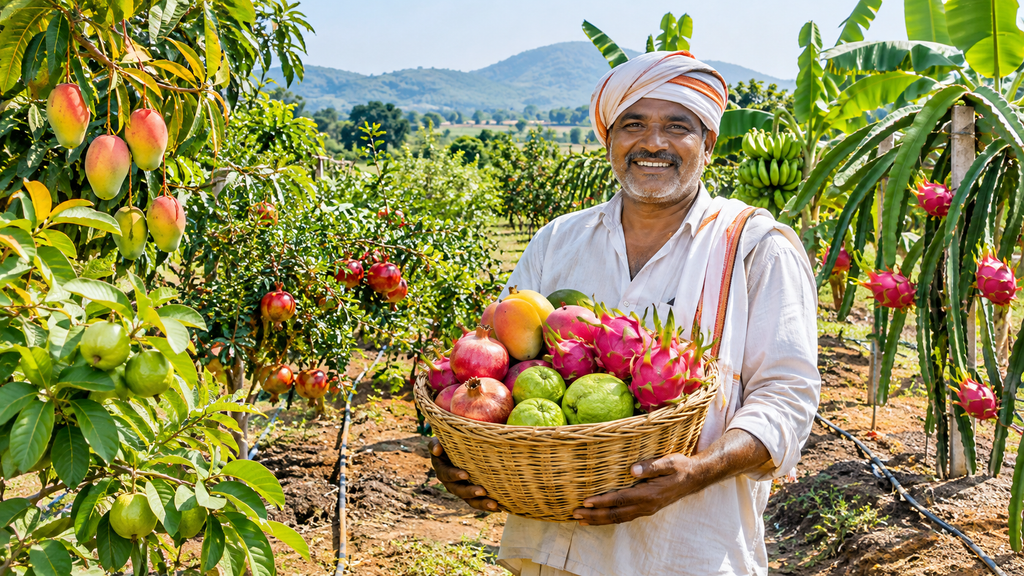
India has diverse climatic conditions ranging from tropical, subtropical to temperate regions. This variety enables the farmers to grow a great variety of fruits throughout the year.
Growing fruits gives a boost to agricultural businesses in different states. From mangoes in Maharashtra to apples in Himachal Pradesh and bananas in Tamil Nadu.
Another important advantage is the increasing demand for fresh, nutritious and naturally produced food. Consumers are buying fruit more often from supermarkets, online grocery sites and local farmers’ markets.
Modern cultivation methods, drip irrigation, high quality planting materials and scientific crop management can also give fruit farming better long-term business opportunities for farmers.
Government horticulture information shows that production of horticulture in India has increased significantly, which shows the growing importance of this agricultural sector.
Top 10 Profitable Fruit Farming Crops in India
Growing Dragonfruit
Dragon fruit farming is drawing the attention of Indian farmers owing to its appealing appearance, growing consumer interest and commercial value.
The crop can be grown in several tropical and subtropical regions provided the farmers use suitable varieties and manage the water resources well. Commercial cultivation of dragon fruit is being considered in Gujarat, Maharashtra, Karnataka and Tamil Nadu.
Dragon fruit plants are usually supported by concrete poles or any other appropriate structures. Drip irrigation helps farmers to supply controlled water. Proper pruning and nutrient management help in healthy plants.
One big advantage is that a well maintained plantation can produce fruits for several years. However, the initial investment in support structures, planting materials and irrigation can be quite expensive.
Thus farmers need to know the local wholesale prices and find reliable buyers for the product before starting large scale cultivation.
Growing Pomegranate
Another promising commercial fruit crop in India is pomegranate. Maharashtra and Karnataka are the major producers of pomegranate and the fruit is in demand in domestic as well as international market.
The Bhagwa is popular among commercial growers owing to its attractive color, fruit quality and market acceptance.
Pomegranate is generally a successful crop in suitable dry and semi-arid climates. Farmers should ensure correct spacing, irrigation schedules and nutrient management for good fruit quality.
Drip irrigation is especially useful as it helps in efficient water management. Farmers should also look out for bacterial blight, fruit cracking and other common orchard problems.
If farmers maintain the quality consistently and make contacts with wholesalers, exporters and processing companies, pomegranate farming is a profitable agricultural business.
GROWING AVOCADO
Rising awareness about healthy food and changing consumer preferences are drawing attention to avocado farming in India.
The fruit is used extensively in salads, sandwiches, smoothies and other food products. The commercial demand is increasing in urban markets offering opportunities to farmers who can produce quality fruits.
Selected varieties of avocado are suitable for cultivation in Karnataka, Kerala, Tamil Nadu and parts of Maharashtra.
But there is a lot of planning involved in growing avocados. Farmers should know the local climate, soil drainage, rainfall and suitable varieties before establishing an orchard.
Good quality planting material and proper pollination management are important for successful production.
Avocado is a fairly niche market so farmers should do research on potential buyers in their area and assess the demand they should expect before making any major investments.
Mango cultivation
Mango is one of the most popular commercial fruit crops in India. Mangoes, known as the king of fruits, have good demand during the summer season.
There are many popular varieties grown in India like Alphonso, Kesar, Dasheri, Banganapalli, Totapuri and Amrapali.
Different varieties are suited to different regions and markets. For example, Alphonso is very popular in Maharashtra whereas Kesar is popular in Gujarat.
The cultivation of Mango can be a source of income for a long period as the matured orchards can yield fruits for many years.
Farmers should pay attention to proper variety selection, pruning, irrigation, nutrient management and pest control. Proper harvesting, grading and packaging affect the final selling price too.
There are other opportunities in mango pulp, juice, pickles, dried mango products and other processed food businesses.
Growing Guava
It is a good choice for farmers looking for a commercial fruit crop with relatively less demanding orchard needs.
Guava is grown in a number of Indian states and is prized for its flavor, nutritional values and multiple uses in the food industry.
Popular varieties are Allahabad Safeda, Lalit, Arka Mridula, Arka Kiran and Lucknow-49.
Guava plants can begin to bear fruit fairly early, compared with many traditional orchard crops. Farmers may also manage seasonal production to target different market periods, depending on variety and cultivation system.
The crop needs proper pruning, irrigation and nutrient management . Farmers should also protect fruits from fruit fly and other pests.
Guava can be sold fresh or supplied to juice manufacturers, pulp-processing units and local fruit vendors.
Papaya Cultivation
For farmers seeking a relatively short term fruit crop, papaya cultivation is a profitable alternative.
Unlike traditional fruit trees, papaya plants can produce fruits in as little as 8 to 12 months under the right growing conditions.
Popular commercial varieties and hybrids include Red Lady, Arka Prabhat and other regionally recommended varieties.
Papaya grows well in warm climates and needs well drained soil. Avoid water logging as too much moisture can damage the roots and increase the disease problems.
Farmers have to be careful with fertilization, irrigation and plant health. Especially for uniform production, it is important to select good quality seedlings.
It is in demand in local markets, supermarkets, juice shops and food processing businesses.
Prices and yields are functions of season, variety and management of the farm. Farming of papaya gives quicker returns than many of the long term orchard crops.
Growing Grapes
In India, grape cultivation is a commercial activity which is settled and concentrated in Maharashtra and parts of Karnataka.
Nashik is famous for its grape production catering to domestic and export markets with fresh table grapes.
Thompson Seedless, Sonaka, Sharad Seedless and other commercially suitable varieties are popular.
Grapes require more technical management than other fruit crops. Farmers need proper trellising systems, pruning schedules, irrigation management and disease-control practices.
The quality of grapes is of great importance as size, color, sweetness and appearance all influence market acceptance.
The farmer can see sales of fresh fruit, production of raisins and processing of juice.
The initial infrastructure and management costs may be high but with good planning grape cultivation can afford attractive commercial possibilities in suitable areas.
Watermelon Farming
In India, growing watermelon is a popular seasonal agricultural business because the duration of the crop is short.
Watermelons are usually ready to pick in about 75 to 100 days, depending on variety, climate and farming practices.
It is cultivated in a number of states, especially where the climate is favorable and irrigation is available.
Watermelon is generally found in wholesale markets, fruit stands, supermarkets, and local shops.
Farmers should choose varieties according to local consumer preference and market demand. Proper field preparation, irrigation, fertilizer application and pest management are all essential for good fruit development.
A major advantage is that watermelon can be a seasonal cash crop, and it does not require a long-term orchard investment.
However, at peak harvest times market prices can change quickly. Farmers should be careful in harvesting and marketing to avoid selling out their whole produce when there is oversupply.
Melon Cultivation
Muskmelon is another commercial fruit crop of good potential for suitable areas in India.
It is sweet to taste and refreshing, popular in summer and in demand among fruit consumers.
Farmers grow muskmelon under appropriate seasonal conditions in states like Gujarat, Punjab, Haryana and Uttar Pradesh.
Depending on the variety and the environment, the crop usually takes 80 to 100 days to be harvested.
Popular varieties should be selected based on the local climate, type of soil and market preferences.
Good water management is essential, particularly during flowering and fruit development. Too much water close to maturity can affect fruit quality.
Muskmelon can be marketed in local markets, wholesalers, supermarkets and fruit shops.
Farmers that predict sowing dates based on market demand may be better poised to obtain attractive selling prices.
Bananas: Growing
Banana is one of the important commercial fruit crops of India. It is consumed all the year round and is used in fresh fruit markets, food processing and traditional foods products.
Tamil Nadu, Maharashtra, Karnataka, Andhra Pradesh and Gujarat are major banana producing states.
Popular varieties are Grand Naine, Robusta, Nendran, Poovan and Red Banana.
Tissue culture banana plants are widely used in commercial farming because they can supply uniform planting material when bought from reliable nurseries.
Banana cultivation needs proper irrigation, nutrient management, drainage and protection from wind damage.
Farmers can get income through fresh banana sales and can explore other markets for banana chips, flour, fiber and other value added products.
Banana farming can be a regular source of income if there is good crop planning and market connections.
Selecting the Best Fruit Crop to Grow on Your Farm
One of the most important decisions before starting a commercial farming business is to choose the right fruit crop.
Farmers should first study the local climate and soil situation. A crop which does well in Maharashtra may not do the same in an area with different rainfall, temperature and soil characteristics.
Another important factor is the availability of water. Some crops need to be watered regularly, others do better under certain dryland conditions.
Then investment. Watermelon and muskmelon usually have shorter culture cycles. Dragon fruit and grapes may require more infrastructure.
Farmers also need to know how far they are from the nearest wholesale markets, how much transport is available and how much local buyers want.
It is better to calculate expected expenses, production, selling prices and market risks instead of choosing a crop just because another farmer is making a good income.
Modern methods for boosting fruit farming income
Modern agricultural technologies can help farmers to increase productivity and manage the costs of cultivation.
Drip irrigation is one of the useful techniques of fruit cultivation as it provides water directly near roots of plants. Properly designed and maintained, it can increase water-use efficiency.
Another technique that is used in some fruit crops is high density planting. It permits the farmer to grow more plants in a given space but it requires suitable varieties, pruning, training and scientific management of the orchard.
Soil testing allows farmers to know the availability of nutrients and apply fertilizers according to crop needs.
Integrated pest management uses monitoring, biological control and recommended crop protection practices to help reduce the use of unnecessary pesticides.
Farmers can also utilize mobile applications and weather prediction services to assist with irrigation planning, monitor rainfall and improve farm management decisions.
Investment and Marketing Prospects in Fruit Farming
The investment in fruit farming depends on crop, land preparation, planting materials, irrigation facility, labor, fertilizers and other infrastructure requirements.
Short-duration crops like watermelon and muskmelon may require less long-term investment than permanent fruit orchards.
The farmers need to be patient with long-term crops such as mango and avocado, as it could take several years before they can get significant commercial harvests.
Plan your marketing before you plant. Farmers can sell directly to consumers, supply wholesale markets, work with supermarkets or link up with food processing companies.
Another opportunity is value addition. Mango pulp, banana chips, dried fruits, guava juice and processed fruit products can be additional business opportunities.
Farmers should also look for eligible government horticulture support programs and subsidies through their state horticulture departments.
Common Challenges in Fruit Farming
There are opportunities in growing fruit, but there are also risks that farmers should not ignore.
Crop production can be affected by unexpected rainfall, drought, temperature changes and pest attacks. Perishable fruits also need careful harvesting, packaging, storage and transportation.
Another big problem is the volatility of the market price. Even a good harvest may not mean a good income if there is too much of the product at one time in the market.
Farmers can minimize these risks through crop diversification, scientific cultivation, proper storage arrangement and advance marketing plans.
Horticulture officers and agricultural universities can also help farmers take better crop management decisions.
Conclusion
Fruit farming is a lucrative agricultural activity in India. It provides a lot of opportunities for farmers who want to diversify their farm activities and create sustainable sources of income.
Dragon fruit, pomegranate, avocado, mango, guava, papaya, grapes, watermelon, muskmelon and banana crops have different commercial advantages.
However, no one fruit crop can be a sure shot to give high profits to all the farmers. Success is determined by climate, soil, water availability, investment capacity, knowledge of cultivation and market demand.
Before starting fruit farming business, farmers should undertake proper research, suitable varieties and realistic financial planning.
With modern agricultural practices, quality improvements and reliable market connections, fruit cultivation can be a promising long-term agribusiness opportunity for Indian farmers.