


Short Overview
Multi-layer farming is a desirable agricultural method for Indian farmers who want to earn more income from limited farmland. Farmers do not grow one crop but plant different crops at different heights and root depths on the same piece of land.
This method of farming helps to make the best use of sunlight, soil nutrients, water and space available. Farmers can establish a productive agricultural ecosystem and earn income from multiple crops in the whole year by intercropping fruit trees, vegetables, spices, tuber crops and climbing plants.
This guide explains how the multi-layer farming works, the benefits, the suitable crop combinations, the investment requirements, the income opportunities and practical steps to start this farming method in India.
What is Multi-Tier Farming?
Multi-layer farming is an agricultural practice where farmers cultivate different types of crops on the same land by arranging them based on their height, root depth, sunlight needs and growth habits.
In conventional agriculture, farmers usually grow one dominant crop in a field. However this approach may lead to some areas of land being underutilized. Another possibility is multi-layer farming in which a number of compatible crops can be grown together by farmers.
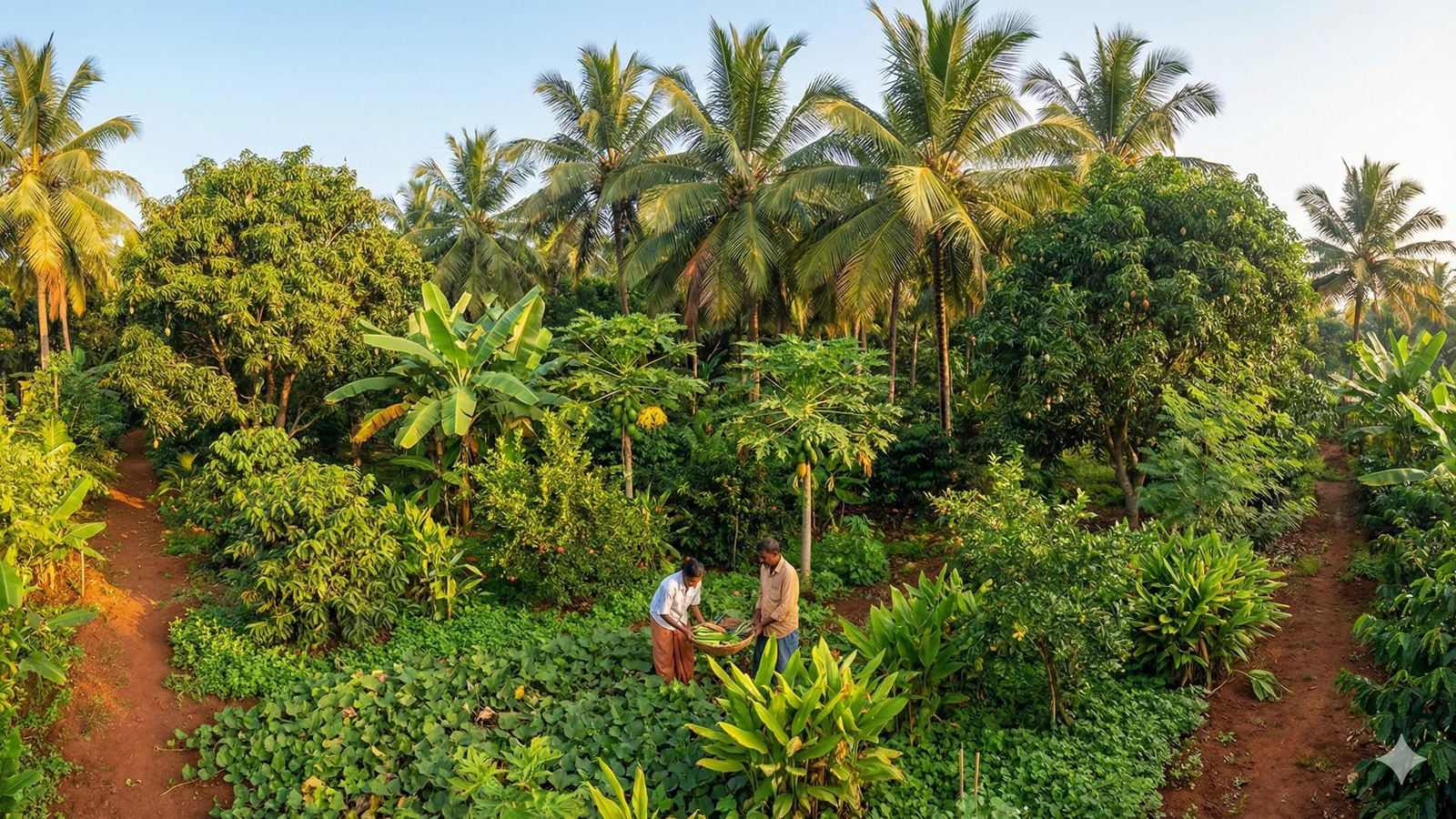
For example, a farmer can grow coconut trees in the upper layer, banana plants in the middle layer, turmeric or ginger at ground level and some vegetables as additional crops. Climbing plants like pepper or bitter gourd can also be included if suitable support structures are available.
The basic idea is this: Rather than growing just one crop on a piece of land, farmers can grow different agricultural products on different levels of the same field.
According to The Better India in its reference article dated October 23, 2025, farmers are looking at this strategy to improve the productivity of their land and earn from multiple harvests.
Why Multi-Layer Farming is Gaining Popularity in India?
Indian agriculture faces several challenges such as small landholdings, changing weather conditions, rising costs of cultivation and uncertain market prices.
One or two crops are the source of all the annual income for many small farmers. Their financial situation can become difficult if the crop fails due to heavy rainfall, drought, pest attacks or market fluctuations.
Multi-layer farming allows for a decrease in the reliance on a single crop.
Farmers can create multiple streams of income by growing different crops together. Some crops may generate income in a seasonal manner. Fruit trees and other long duration crops may generate returns over a longer period of time.
Another major reason for its rising popularity is the farmland efficiency. A system with intelligent design can make better use of the available sunlight, vertical space and soil resources.
This approach can also be used for India’s small and marginal farmers who need to get higher yields from their limited agricultural land.
How Does Multi-Layer Farming Work?
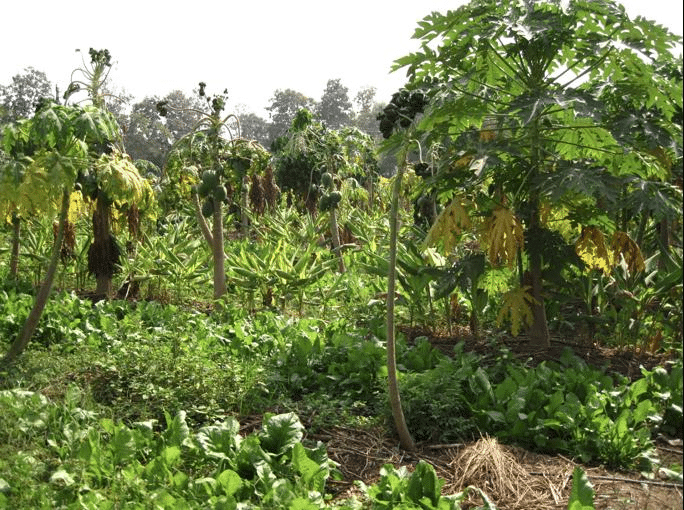
Multi-layer farming is based on the arrangement of compatible crops according to their growing characteristics.
A farm is like a building with many stories. Each crop grows at a different level so they are not competing for exactly the same space.
Upper layer: This can be formed by tall crops like coconut, arecanut, mango and other suitable fruit trees. Those crops mean sustainable farming.
Middle layer: Depending on the available sunlight and the local climate, banana, papaya, coffee and other medium-height crops can be placed in the middle level.
Lower layer: Turmeric, ginger, colocasia and shade tolerant vegetables can be grown close to the ground when soil and moisture conditions are appropriate.
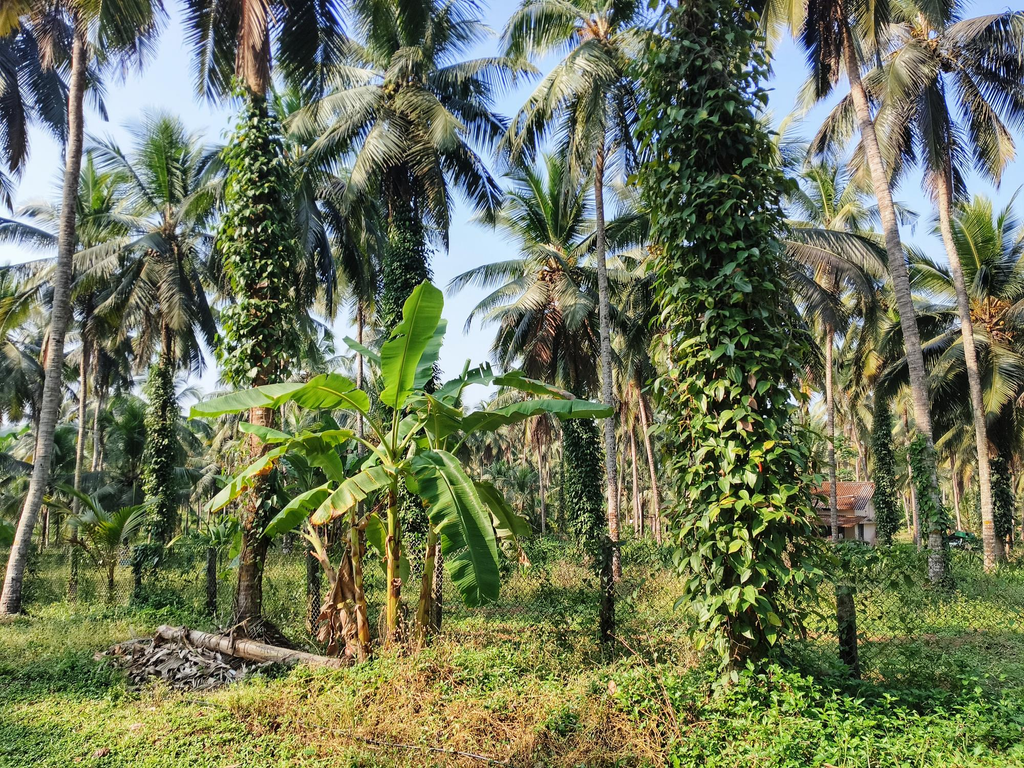
Climbing layer: Suitable trees, trellises or support structures can be used to grow black pepper, bitter gourd, beans and other climbing crops vertically.
Root and soil layer: Different crops have different roots patterns. Choosing plants with similar root structure can help to use soil resources efficiently.
But don’t assume every crop combination is going to work, farmers should not assume. Choose crops taking into account excessive shade, competition for water, pests and nutrient needs.
Best Crops for Multi Layer Farming in India
Choosing the right crops is one of the most important decisions in the planning of profitable multi-layer agriculture.
India has a variety of climate zones, soil conditions as well as rain fall patterns. Thus, farmers should choose crops based on their local agricultural environment.
Coconut: Coconut is one of the important long-term plantation crops in southern states of India, mainly in Kerala, Karnataka and Tamil Nadu. Intercrops can provide additional income from the same plantation if suitable are chosen.
Banana: Banana is a rather fast growing crop and can give income in season. It can be integrated into suitable plantation systems where there is enough sunlight, water and spacing.
Turmeric: It is a useful crop for the lower layer when the conditions are warm and humid. It prefers partial shade and is found in soils that are moist enough.
Another possible intercropping species for selected plantation systems is ginger. It requires good drainage and healthy planting material for successful cultivation.
Black pepper : Black pepper is a vine spice crop and may also use appropriate live standards or support structures. It is particularly relevant in appropriate humid tropical farming areas.
Papaya: Papaya gives comparatively early fruiting and can be incorporated in selected mixed crop arrangements.
Colocasia: Colocasia is a tuber crop, suitable for growing in moist soil conditions and can be used as an additional income-generating crop.
Vegetables Leafy vegetables, beans, gourds and other seasonal vegetables can provide farmers with a steady supply of marketable produce when conditions are suitable for growing.
The trick is to select crops that complement each other, not simply to fill all the space available.
Profitable Multi-Layer Farming Crop Combinations
Farmers can experiment with different crop combinations based on their region, water availability and market demand.
ICAR-Central Plantation Crops Research Institute
| Farming combination | Suitable crops |
| Coconut-based farming | Coconut, banana, turmeric and pepper |
| Arecanut-based farming | Arecanut, black pepper, banana and ginger |
| Fruit-based farming | Mango, papaya, vegetables and pulses |
| Tropical mixed farming | Coconut, banana, colocasia and vegetables |
| Vegetable-based farming | Gourds, leafy vegetables and climbing beans |
For example, farmers in Karnataka and Kerala may explore coconut-based or arecanut-based systems with suitable intercrops. However, crop selection should consider local rainfall, soil drainage, irrigation and the age of the main plantation.
In northern and central India, farmers may need different combinations based on temperature, winter conditions and water availability.
The Indian Council of Agricultural Research has also documented multilayer horticulture systems that combine cucurbit crops with leafy vegetables to improve the use of available land resources.
Multi-Layer Farming: The Farmer’s Benefits
Improved use of agricultural land
A big benefit is that a farmer can plant many different crops on the same plot of land. Instead of relying on one agricultural product, they can use different levels of growing to increase the output of their farms.
Several streams of income
“By multi-layer farming, farmers can make money from different crops, at different times. For example, seasonal vegetables may give returns over a short period, while banana and fruit crops may generate income over longer growing periods.
This would release farmers from the financial pressure of having to wait for one annual harvest.
Improved biodiversity on farms
Planting different crops together can increase the diversity of plants on the farm. A diversified agricultural system may sustain beneficial organisms and allow pest management to be more balanced.
But diversity of crops does not necessarily prevent pest attacks. But still constant monitoring and adequate crop protection are indispensable.
Efficient use of resources
We can make use of the range of sunlight and soil resources by choosing crops wisely. Mulching, drip irrigation and management of organic matter can further enhance resource efficiency.
Less dependence on a single crop
If one crop has a price decline or a production problem, other crops may still generate income. This doesn’t eliminate agricultural risks but can help spread them.
Better job opportunities
Different crops have to be planted, tended, harvested and marketed at different seasons. This can create additional work opportunities for farm families and farm workers.
Investment Required to Start Multi-Layer Farming
The investment required for multi-layer farming depends on the size of the farm, crop selection, planting materials, irrigation facilities and support structures.
Farmers who already own a coconut or arecanut plantation may be able to begin with selected intercrops without developing an entirely new farm.
However, starting a new multi-layer farming project may require investment in land preparation, soil improvement, seedlings, irrigation pipes, labour, fencing and crop protection.
| Investment component | Purpose |
| Land preparation | Field cleaning and soil preparation |
| Quality seedlings | Healthy and suitable planting material |
| Drip irrigation | Efficient water management |
| Organic manure | Improving soil fertility |
| Support structures | Supporting climbing crops |
| Labour | Planting and regular maintenance |
| Crop protection | Managing pests and diseases |
There is no single investment figure suitable for every farmer. A small vegetable-based model may require a different budget from a long-term coconut and pepper plantation.
Before starting, farmers should prepare a detailed budget covering initial investment, annual maintenance expenses and the expected time before each crop starts generating income.
It is also wise to begin with a small demonstration area before expanding the entire farm.
How to start multi-layer farming: A step-by-step guide
TN farmer turns coconut losses into profits with multi-crop, tree-based farming, UN-honoured | CurrentIndia
currentindia.com
Step 1: Learn About Your Farmland.
First of all you need to understand the soil type, rainfall, drainage, temperature and water availability. A soil test can highlight nutrient deficiencies and help guide fertilizer application.
Step 2: Choose the main crop.
Select an appropriate main crop based on your region and market needs. Coconut, arecanut and selected fruit trees can be the main crops in suitable locations.
Step 3:Select appropriate intercrops.
Select other crops according to height, light requirements, root development, water requirements and harvest times. Don’t pack the field.
Step 4: Till the soil.
Clear the field, add appropriate organic matter and improve drainage where necessary. Prepare planting spaces at the recommended spacing for the crop.
Step 5: Establish irrigation facilities.
Drip irrigation can help in the efficient supply of water to various crops. Irrigation schedules have to be adapted to the requirements of the crop, the soil moisture and the weather conditions.
Step 6: Keep a close eye on nutrients.
Different crops need different amounts of nutrients. Apply the same quantity to each plant. Use soil-test recommendations, organic manure and balanced fertilization.
Step 7: Watch out for pests and diseases.
Inspect leaves, stems, roots and fruits regularly. Integrated pest management can help you manage problems while cutting down on unnecessary pesticide applications.”
Step 8: Marketing and Harvest Planning.
Know your nearby markets, wholesalers, retailers and direct customers prior to planting commercial quantities. Harvesting schedules should correspond to market demand and crop maturity.
What is the income of farmers?
Income is one of the main reasons that farmers are interested in multi-layer farming.
A well-planned system can generate income from several crops and not be reliant on one harvest. However, realized profits are dependent on the productivity of the crop, local selling prices, labor expenses, irrigation costs and market access.
The Better India’s reference article cites the example of Biju Narayanan from Kerala’s Kannur. He runs a mixed farm growing coconut, mangosteen, pepper, banana and crops such as ginger or tapioca. His farm model gives earnings of up to ₹15 lakh an acre, says the article.
This is one individual farm, and does not guaranty income for each and every farmer.
A new farmer can’t expect the same immediate returns. Commercial crops with a long duration require time to mature and their returns depend on planning and management over several years.
To avoid surprises, calculate the expected income from each crop separately for better financial planning. Deduct the costs incurred on seedlings, fertilizers, irrigation, labor, transportation, harvesting and marketing.
This will give a better picture of the farm’s annual profit.
Problems in Multi-Layer Farming.
Multi-layer farming provides a number of opportunities but also comes with challenges.
The first question is what to plant. Incompatibility in crops may lead to competition for sunlight, water and nutrients when planted together.
The second challenge is the management of farms. Different crops have different growth cycles, so farmers need to know the individual needs of the crops.
Management of pests and diseases may also be complicated with the growth of several crops. Monitor the field regularly and apply suitable crop protection measures.
Another challenge is marketing. Growing multiple crops is beneficial only when farmers can sell their produce at reasonable prices. Some crops may have limited demand or require specialized buyers.
There can also be high initial investment and labor requirements which may be difficult for farmers with limited financial resources.
For this reason agricultural experts advise starting off with an easy to handle crop combination and to scale up gradually after knowing the results.
Government Schemes and Help for Farmers
Indian farmers can explore government agricultural programs that assist in horticulture, irrigation, crop diversification and sustainable farming.
Mission for Integrated Development of Horticulture (MIDH) supports the eligible program components for developing horticulture activities. Farmers should consult current state-level guidance and any assistance that applies before making an investment.
nhb.gov.in
The Pradhan Mantri Krishi Sinchayee Yojana (PMKSY) aims at improved irrigation access and efficient water use. Its Per Drop More Crop component supports micro-irrigation activities subject to applicable guidelines.
Press Information Bureau+1
The National Mission for Sustainable Agriculture (NMSA) promotes sustainable agriculture and integrated farming systems.
Farmers can also contact their nearest Krishi Vigyan Kendra (KVK), agriculture department or horticulture department for technical advice.
Note that eligibility for subsidies, financial assistance and application procedures may vary between states and scheme components.
Is multi-layer farming good for small farmers?
Yes. If the choice of crops is based on the availability of land and resources, multi-layer farming can be a good option for small and marginal farmers.
A farmer with a small amount of land does not always have to go into large-scale commercial plantations. It may be useful to begin by utilizing a small area of the field to test the crop’s compatibility, the labor required and the market for the product.
For example, a coconut farmer can consider suitable intercrops like banana, turmeric or ginger depending on the availability of sunlight and soil conditions.
Similarly, small vegetable plot farmers might try vertical cultivation with climbing vegetables and suitable support structures.
The most important thing is good planning. Farmers should not invest heavily in crops without knowing their production costs and possible buyers.
Future of Multi Layer Farming in India
With Indian agriculture focusing more and more on diversifying crops, efficient use of resources and sustainable production, multi-layer farming seems to have a promising future.
Farmers are seeking better ways to improve agricultural productivity without continuous expansion of cultivated land. One solution could be multi-layer farming that makes better use of existing farmland.
Research institutions like ICAR are working on diversified horticultural production systems by integrating compatible crops at different canopy levels. These methods can help farmers to understand how to improve the land utilization by scientific crop planning.
Technology can also help with the management of multi-layer farms. Drip irrigation, soil testing, weather prediction, farm management applications and modern crop protection techniques can help farmers make better decisions.
Multi-layer farming could be an important option for farmers wanting to engage in horticulture, mixed cropping and sustainable agricultural businesses in the coming years.
But its success will depend on practical field research, local crop suitability, farmer training and access to reliable markets.
Conclusion
For Indian farmers looking to optimize their available agricultural land, multi-layer farming is an interesting opportunity. Farmers can grow a variety of compatible crops at different levels and diversify their income streams instead of relying on a single crop.
From coconut and banana to turmeric, ginger, pepper and vegetables, the right mix can help create a productive and diversified farming system.
But proper planning, soil testing, crop selection, irrigation management and market research are required for successful multi-layer farming. “Farmers should not just follow the high-income success stories blindly because every farm has different conditions and investment requirements.
A practical approach would be to begin on a small scale, learn from agricultural experts and expand the farming system gradually.