



Short Overview
Almond cultivation is getting a lot of popularity in India these days. The demand for dry fruits and premium nut crops is increasing. Farmers value almonds because they are nutritious, have a good shelf life and fetch good market prices. Almonds need a particular climate to thrive but if you can grow them, you’ll get great returns over the long term.
Cultivating almonds could be an interesting long-term opportunity for Indian farmers who have the right climate, suitable land and patience to grow an orchard. Almond is not something that can be grown anywhere and be successful. It does best in suitable temperate and cold areas where winter chilling, spring conditions, soil drainage and summer weather are suitable for good flowering and nut development.
Almond production in India is still limited to certain parts of the country, particularly Jammu and Kashmir and Himachal Pradesh. Jammu and Kashmir still has the largest share in India’s almond production, according to the latest government data.
Introduction to Almond Cultivation
Almond (Prunus dulcis) is a deciduous nut tree belonging to the family Rosaceae. Almond trees bloom early in spring and need cold winters and dry summers to be able to produce good quality nuts.
India imports huge quantity of almonds every year. This gives rise to strong opportunities for domestic production in suitable agro-climatic zones.Almond is one of the most valuable tree nuts consumed in India. It is widely used in homes, sweets, bakery products, beverages and food products. Because of its nutritional value and strong consumer demand, almonds have an established market.
But growing almonds is very different from growing many common fruit crops. The almond tree needs specific environmental conditions, especially during winter and early spring. This is why commercial almond cultivation in India is mainly associated with suitable temperate areas.
According to the National Horticulture Board, almond cultivation in India has historically been concentrated mainly in Jammu and Kashmir and Himachal Pradesh.
Climate Requirements for Almond Growing
Almond trees need a temperate climate with cold winters.
Optimum temperature range 15°C to 30°C
Chilling requirement: 300-500 hours under 7° C.
Dry climate at the time of flowering and nut maturity
Frost at flowering can reduce yield
Almonds are more tolerant to drought than many fruit crops.
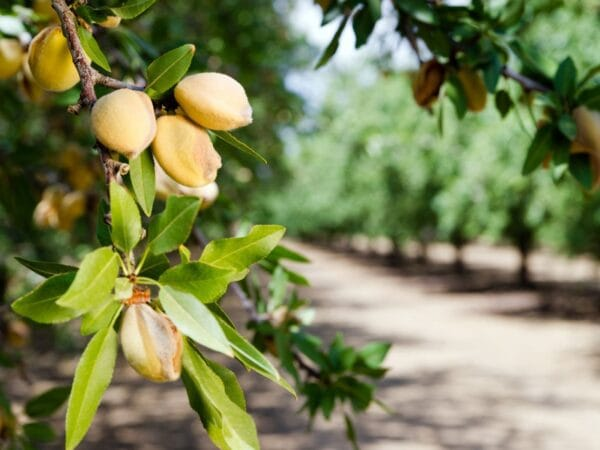
Soil Requirements
Almonds need well drained soils.
Best soil type: Sandy loam to loam soil.
soil pH 6.0-7.5
Deep soils encourage root growth
Don’t plant in water-logged or saline soils.
Where Are Almonds Grown in India?
Jammu and Kashmir is the major almond-producing region of India. Important almond-growing areas include parts of the Kashmir Valley, where the climate provides suitable winter conditions for temperate nut crops.
Himachal Pradesh is another important region for almond cultivation. ICAR also identifies almonds among the important fruit crops grown in the state’s horticulture-based farming systems.
Some colder areas of Ladakh and other Himalayan regions may also support almond cultivation under appropriate local conditions. However, suitability should always be assessed at the individual farm level because elevation, frost exposure, water availability and local temperature patterns can vary considerably.
This concentration tells us something important: almond farming is a location-sensitive business.
Major Almond Growing States of India
Almond cultivation in India is largely limited to:
Jammu & Kashmir (largest producer)
Himachal Pradesh Ladakh (cold desert regions)
Uttarakhand Parts
These regions are characterised by conditions suitable for winter chilling and dry summers.
Popular Almond Varieties Grown in India
Mamra Almond
Premium variety known for high oil content and rich taste. Mostly grown in Kashmir.
Waris
High-yielding variety with medium-sized nuts and good kernel recovery.
Shalimar
Suitable for higher altitudes with good adaptability.
Pranyaj
Improved variety with uniform nut size and better productivity.
California Paper Shell (Limited Trials)
Grown experimentally in select regions with favorable climate.
Propagation Method
Almond trees are propagated vegetatively to maintain variety purity.
- T-budding
- Shield budding
- Grafting on peach or almond rootstock
Using healthy nursery plants ensures uniform growth and early bearing.
Planting Season and Spacing
Almond saplings are planted during dormancy.
- Planting season: December to January
- Spacing: 6 m × 6 m
- Pit size: 1 m × 1 m × 1 m
Pits should be filled with topsoil mixed with compost before planting.
Manure and Fertilizer Schedule
Balanced nutrition improves nut quality and yield.
- FYM: 30–40 kg per tree annually
- Nitrogen: Split application during spring
- Phosphorus & Potassium: Applied in winter
Soil testing helps determine exact nutrient requirements.
Irrigation Management
Almond trees are moderately drought-tolerant but benefit from timely irrigation.
- Young plants: Regular irrigation during establishment
- Bearing trees: Irrigation at flowering and nut development stages
- Avoid over-irrigation to prevent root diseases
Drip irrigation improves water-use efficiency.
Training and Pruning
Proper training and pruning improve sunlight penetration.
- Open center system is commonly used
- Pruning is done during winter dormancy
- Remove dead, diseased, and crossing branches
Pest and Disease Management
Common pests and diseases affecting almond orchards include:
- Aphids
- Stem borers
- Leaf curl disease
- Shot hole disease
Maintaining orchard hygiene and regular monitoring helps reduce losses.
Flowering and Pollination
Most almond varieties require cross-pollination.
- Plant compatible varieties together
- Honeybees play a vital role in pollination
Poor pollination directly reduces nut yield.
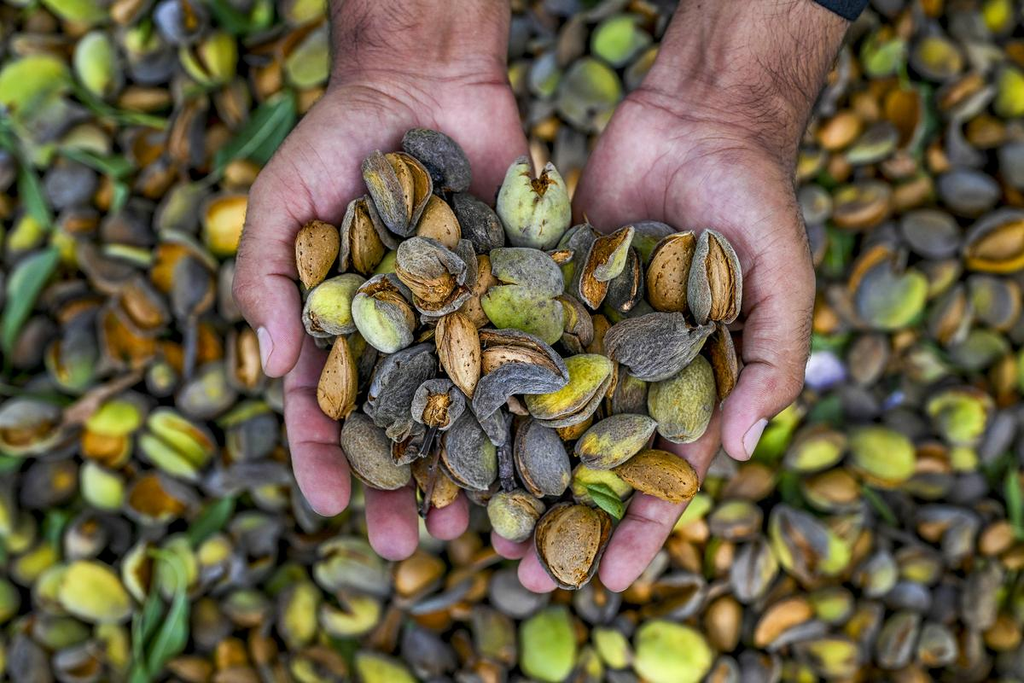
Harvesting of Almonds
Farmers harvest almonds when the hull splits open naturally, indicating full maturity.
- Harvesting season: August to September
- Farmers shake trees or hand-harvest the fruits
- They dry the nuts properly before storage
Yield of Almond Crop
Yield depends on variety, age, and orchard management.
- Yield per tree: 8–12 kg of kernels
- Yield per hectare: 1.5–3 tonnes
Post-Harvest Management
Proper post-harvest handling ensures long shelf life.
- Dry nuts to safe moisture level
- Store in cool, dry conditions
- Grading improves market price
Almond Yield and Profit Potential
Yield is one of the most searched topics when farmers consider almond farming in India, but it is also one of the easiest areas to misunderstand.
There is no single yield figure that applies to every orchard.
Tree age, variety, rootstock, pollination, climate, irrigation, pruning, soil fertility and orchard density all affect production.
That should not be interpreted as a guaranteed yield for every farmer. It demonstrates what improved orchard management can achieve under suitable conditions.
For a realistic almond farming profit calculation, farmers should consider land preparation, planting material, irrigation, fencing, labour, fertilizers, pest management, pruning, harvesting, drying, storage, transportation and market prices.
Because an orchard takes several years to mature, almond farming should be viewed as a long-term investment rather than a quick-income crop.
Is Almond Farming Profitable in India?
Almond farming can be profitable when the location, planting material and management system are right.
The biggest advantage is that almonds are a high-value nut with established consumer demand. The biggest limitation is that the crop requires a specific climate and takes time to develop.
This makes almond farming more suitable for farmers who already have appropriate land in a temperate region rather than someone trying to force the crop into an unsuitable warm climate.
Before investing, farmers should calculate the expected establishment cost, yearly maintenance expenses and realistic production timeline. They should also identify potential buyers before the orchard reaches commercial production.
ICAR has specifically highlighted the potential of improved temperate horticulture, high-density planting, better planting material, post-harvest practices and marketing systems for improving farmer returns in Jammu and Kashmir.
Conclusion
Farmers achieve the best results in temperate and cold regions when cultivating almonds in India. By selecting suitable varieties, managing orchards properly, and ensuring good post-harvest care, they can turn almond farming into a sustainable and profitable dry fruit enterprise.
Almond cultivation in India offers an interesting opportunity for farmers in suitable temperate and high-altitude regions, but success starts with choosing the right location.
The almond tree needs appropriate winter chilling, suitable spring weather, good drainage, reliable water management and careful pollination. Variety selection is equally important because different cultivars respond differently to local conditions.
Modern orchard practices can also make a significant difference. ICAR research has demonstrated the potential of improved planting material, closer orchard systems, drip irrigation, pruning and managed honeybee pollination for increasing almond productivity under suitable conditions.

