

Short Overview
Food goes through many stages from farm production to harvesting, processing, storage, distribution, and retail, to the consumer. Agribusinesses need to know where products come from, how they are handled and where they are going at each step. These records are connected through a food traceability system to provide transparency across the journey of the product.
Traceability is now an operational necessity for modern farms, food processors, exporters, plantations, food and beverage companies and scattered grower networks rather than just a compliance exercise. Connected data can be used to manage recalls, trace product origins, investigate quality issues, fill information gaps and make supply chain decisions.
For agribusinesses, a food traceability system provides a transparent record of where a product originated, what happened to it, and where it went next. That visibility makes it safer and easier for farms, processors, distributors, exporters, retailers and food brands to run operations. It can help reduce the time to investigate quality problems, support recall readiness, increase supplier accountability and help customers feel more confident in the food they buy. This guide explains how modern food traceability works, and how businesses can implement a practical farm-to-fork process, without unnecessary complexity.
What Is a Food Traceability System?
A food traceability system is a systematic way of documenting and linking information of a food product through the different steps in the supply chain. Businesses can connect farm, crop, batch, processing, inventory, transportation and destination data to trace products back or forward when needed.
A practical traceability framework can give answers to questions as:
- Where was it made?
- Who was the supplier, grower, plot or farm?
- When did you get it or harvest it?
- What batch is it part of?
- What was involved in the handling/processing?
- Where was the item shipped or stored?
- Which market, distributor or consumer got it?
The amount of data recorded is influenced by the product, business strategy, legal requirements and operational procedures.
What Is Food Traceability and How Does It Work From Farm to Fork?
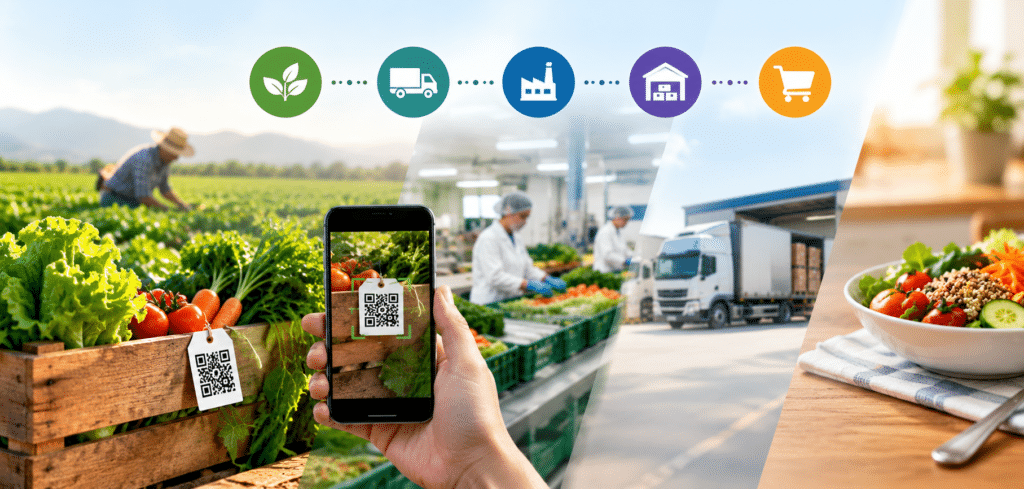
Traceability is about connecting records done at different points of the supply chain. Instead of storing data separately, businesses link products, batches, activities, locations, and transactions.
This is the usual process:
- Farm registration and profiling can collect information on farms, plots, farmers, locations and production activities.
- Crop and activity log: Document inputs, harvesting, inspections, cultivation activities, and other significant events.
- Identify the harvest by linking the harvested produce to the corresponding farm, plot, crop, date and batch.
- Processing and transformation: Link the raw materials to the final batches and processing operations
- Inventory movement: Stock changes, dispatches, transfers, storage, and receiving.
- Distribution: Know where batch shipments and recipients/destinations are located.
- Trace-back and trace-forward: Track linked records to trace the source of a batch or to determine the distribution of affected products.
This creates a farm to consumer traceability system that can provide visibility over the different operational stages.
Why agribusiness needs a food traceability system
This is why a food traceability system is important. Food companies need to understand product movement, production history and links in the supply chain. When data is spread out across spreadsheets, paper records or disparate applications, investigating an issue is tedious and difficult.
The primary benefits are:
Better Food Safety Management
For businesses, traceability can link products to their production and handling history. If quality or safety issues arise, relevant records can help teams investigate the affected product and identify which batches or supply chain steps need attention.
Traceability is not a food safety guaranty. Rather, it provides information that supports food safety management, research and corrective action.
Speed up product recall investigations
Corporations can minimize the number of human searches undertaken when investigating a potentially affected product by having information about the batch, source, processing history and distribution channel of a product.
An integrated food batch-tracking system can help make it easier to find relevant information and quantify the size of a potential problem.
Increased Supply Chain Visibility
Modern agribusinesses can work with many farmers, suppliers, warehouses, processors, distributors and consumers. Connected records can help organizations better understand the movement of goods between these participants.
This will be especially helpful for businesses that operate in multiple locations or run distributed grower networks.
Better Operations Management
Traceability data could comprise information other than compliance records. Combined with agricultural and operational data, it can help managers understand production volumes, batch flows, inventory locations and process histories.
This improves communication between the teams in field operations, procurement, processing, inventory and distribution.
Buyers and customers feel more confident
Consumers and business customers are demanding more information about the origins of food and its supply chain. Companies that have reliable product histories are better positioned to share handling and provenance information.
What data should a traceability solution record?
The information required varies by industry and product, but an effective traceability framework commonly connects several data categories.
| Data Area | Examples |
| Farm & plot | Farm ID, plot, location, grower |
| Crop | Crop type, variety, season |
| Production | Activities, inputs, inspections |
| Harvest | Date, quantity, source |
| Batch | Batch ID, lot details |
| Processing | Processing event, transformation |
| Inventory | Receipt, storage, movement |
| Logistics | Shipment, destination, dispatch |
| Customer | Buyer, distributor, destination |
An agricultural product tracking system can connect these records so businesses can follow products from their production source through subsequent supply chain stages.
Traditional Record Keeping vs. Traceability in the Food Supply Chain
Information is frequently stored separately in traditional record keeping. Distribution teams may use multiple systems, warehouses may handle inventory independently, and farm teams may keep production records.
Traceability of the food supply chain links these records based on identifiable goods, batches, places, and occasions.
This distinction is important because traceability necessitates linkages between records rather than just a bigger document collection.
For instance, it is helpful to know that 500 kg of food were collected. Significantly more operational context is created by knowing which plot generated it, which batch it entered, where that batch was processed, how much was despatched, and which destination got it.
Key Features to Look for in a Traceability Platform
Agribusinesses should evaluate traceability technology according to their operational requirements rather than choosing a system based only on feature count.
Important capabilities may include:
- Unique farm and plot identification
- Batch and lot management
- Crop and activity records
- Harvest data capture
- Inventory integration
- Procurement and supplier records
- Processing and transformation tracking
- Shipment and destination records
- Role-based access
- Mobile field data collection
- Offline data capture where connectivity is limited
- Dashboards and reporting
- Integration with ERP and other business systems
- Audit-friendly historical records
For organizations operating across large or geographically distributed areas, mobile and offline capabilities can be particularly useful for capturing field information closer to its source.
How do agribusinesses implement traceability effectively?
Technology is just one component of a traceability program. Companies also require dependable data and repeatable processes.
- Product Journey Mapping
Describe each major step from production to the final destination. • Where products change ownership, location, form or batch - Develop Identification Rules
Create unique IDs for farms, plots, crops, harvest, batches, inventory movements, and shipments. - Link Operational Data
Consolidate related information on production, procurement, processing, inventory and distribution into a cohesive workflow. - Standardize data gathering
Specify what information is to be recorded, when it is to be recorded and who is to enter or validate it. - Test Trace-Back and Trace-Forward Processes
It’s a good idea to periodically test the ability of companies to trace a product back to its source and forward to its downstream destinations using the records they have. - Data Quality Monitoring
Incomplete, duplicated or inconsistent records compromise traceability. Regular validation ensures that operational data is reliable.
Common Traceability Problems
There are often a number of practical problems when agribusinesses attempt to implement traceability.
Disconnected systems: Departments may be using different applications that don’t share information.
Manual records: Paper records can be prone to errors and take longer time to retrieve information.
Inconsistent identification: Farms, batches or suppliers can have different naming conventions, making it hard to link records.
Poor field connectivity: It can be challenging to enter data in real-time when in remote production areas with limited internet access.
Poor data adoption Even if the platform is technically competent, it can underperform if employees and field teams do not consistently record the required information.
The answer usually includes a combination of the right technology, standard processes, training and ongoing data governance.
How KhetiBuddy Powers Connected Operations in Agribusiness
When organizations are faced with complex agricultural operations, traceability is more useful when integrated with farm and supply chain processes rather than an isolated database.
KhetiBuddy has capabilities around farm registration and profiling, farm and plot management, crop management, operational data capture, procurement, inventory and traceability workflows. This connected approach can help businesses create a consistent flow of information from field-level operations to downstream supply chain activities.
Organizations can also connect traceability to Enterprise Farm Management Software to integrate production and operational records into a wider farm management workflow.
Agri Supply Chain Management Software can link procurement, inventory, movement and related processes to traceability requirements for businesses with broader agricultural supply chains.
What Should a Business Consider When Choosing a Traceability System?
Before choosing technology, assess the real traceability needs of the business.
Think about:
Product complexity: Does the business deal with single-origin products, mixed materials or multiple transformations?
Scale of operation: How many farms, plots, suppliers, facilities and destinations?
Data needs: What production, batch, inventory and logistics data should be linked?
Field conditions: Require mobile or offline capabilities?
Integration: Does the solution have to integrate with ERP, procurement, inventory or other systems?
Reporting. What operational, audit or customer reports are needed?
Scalability – Does the system allow for additional farms, crops, locations and business units?
Any solution should align with the organization’s real workflows, instead of requiring teams to keep duplicate records.
Food Traceability Future in the Agribusiness Sector
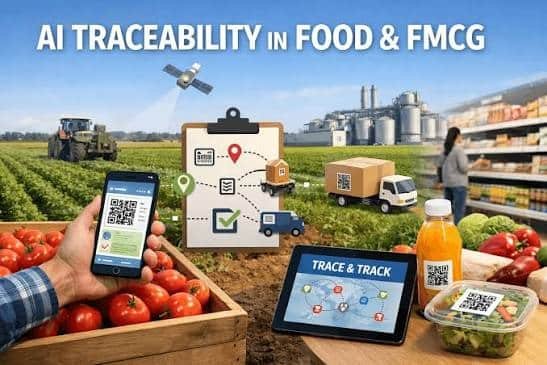
Traceability is evolving toward more connected, data-driven operations. Cloud platforms, mobile field applications, satellite data, IoT devices, analytics and system integrations provide additional context around agricultural production and product movement.
The future isn’t only about more data to be recorded. It’s about making data consumable and connectable, so organizations can have access to it when they need to investigate a batch, look at the history of production, track inventory or improve supply chain coordination.
As farm businesses become more geographically dispersed and supply chains more complex, integrated traceability will increasingly be integrated with farm management, procurement, inventory, processing and enterprise systems. Read on to find out how connected traceability can help improve visibility and control across agricultural operations.
Conclusion
A food traceability system provides a structured way for agribusinesses to link data from production, batch, processing, inventory, and distribution. Its value is not limited to just meeting traceability requirements; reliable product records can support food safety investigations, operational visibility, recall management, supply chain coordination and greater transparency.
A food traceability system provides modern agribusinesses with reliable visibility.
It helps teams see where food comes from, what happened in production and handling, and where the product went next.
When used properly, traceability can enhance food safety, improve recall readiness, aid quality control, reduce operational ambiguity, and help communication with suppliers and customers.
It can also provide managers with better information for day-to-day decisions.
The best way is not to digitize everything at once.
Start with the most important products, batches, events and locations. Establish transparent procedures, select technology that suits the users and conduct frequent system testing.
Digital traceability is a practical way for farms, processors, exporters, distributors, retailers and food brands to create a safer, more transparent and more resilient food supply chain.