


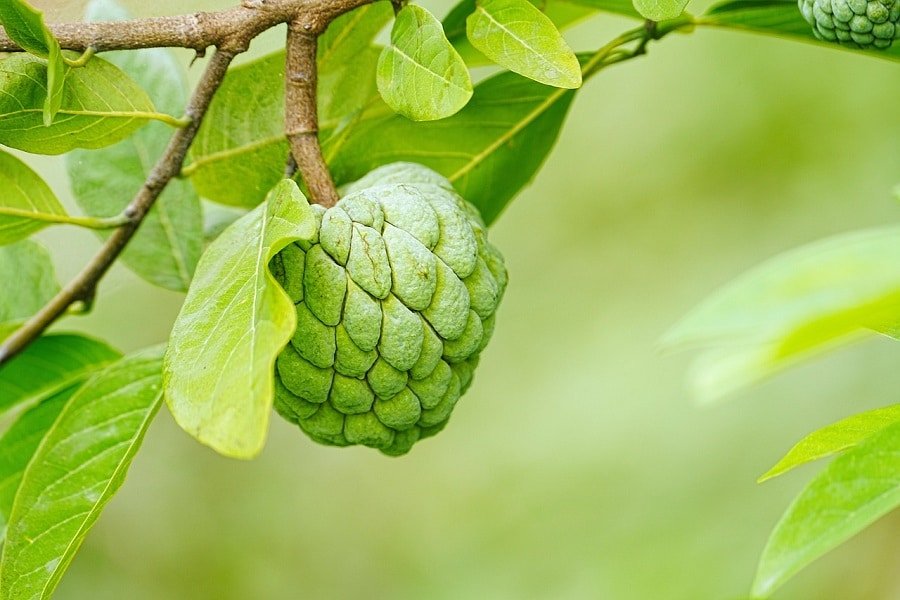


Custard apple (Sitaphal or Sharifa) has emerged one of the most promising fruit crops of India, particularly for dryland and rainfed farming systems. Maharashtra, producing 7,000 hectares against India’s total 55,000 hectares, is leading the production of this hardy fruit and transforming the livelihoods of farmers in drought-prone regions. The natural sweetness of the fruit, its creamy texture and its outstanding nutritional profile have driven strong demand in domestic markets, while its long shelf life and transport tolerance have opened up export opportunities.
For the Indian farmer, the cultivation of custard apples is a strategic step toward climate resilient agriculture. Farmer-developers such as Navnath Kaspate from Solapur have pioneered recent innovations. NMK-1 (Golden) is a high-yielding variety that can produce up to 12 tons per acre – more than twice the yield of traditional varieties. The crop’s commercial prospects are further boosted by the government’s continued support through MIDH subsidies and the ongoing effort to secure a GI tag for Telangana’s famous Balanagar variety. This detailed guide has all the information you need to start and manage a profitable custard apple orchard in 2026.
Quick Crop Overview
| Parameter | Details |
|---|---|
| Scientific Name | Annona squamosa L. |
| Family | Annonaceae |
| Origin | Tropical America, introduced by Portuguese in 16th century |
| Climate | Tropical and subtropical; thrives in warm, dry conditions |
| Ideal Temperature | 15°C – 38°C (tolerates high heat) |
| Rainfall | 500-800 mm annually; prefers dry weather during fruiting |
| Soil & pH | Well-drained sandy loam, lateritic, light black soils; pH 6.0 – 7.5 |
| Planting Season | July – August (Monsoon) or February – March (Spring) |
| Spacing | 5 m x 5 m (standard) to 4 m x 4 m (high density) |
| Plants per Acre | 160 – 200 plants |
| Fruiting Starts | 3rd – 4th year |
| Full Bearing Age | 6th – 7th year onwards |
| Harvesting Season | September – January (main crop) |
| Average Yield per Plant (Mature) | 50 – 100 fruits per tree |
| Yield Per Acre (Mature Orchard) | 5 – 12 tonnes (variety-dependent) |
| Economic Lifespan | 15 – 20 years |
About Custard Apple Fruit
Custard Apple Fruit Info
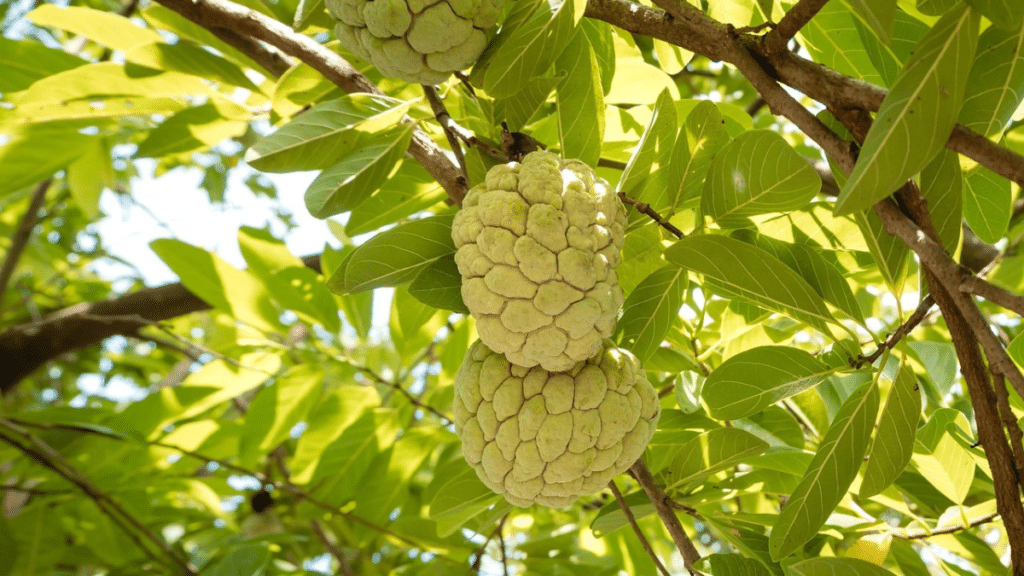
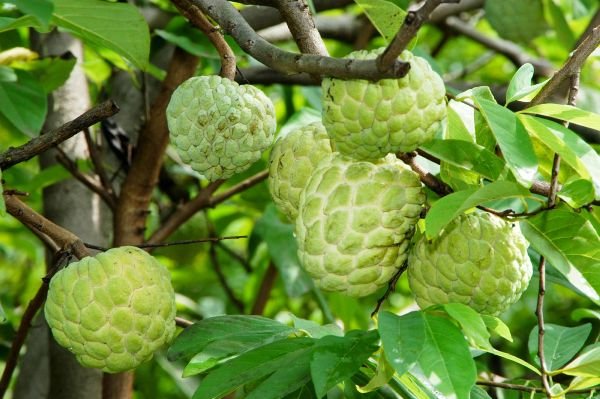
Custard apples are heart-shaped to round, and have the characteristic quilted skin which turns yellowish green to brown when ripe. The fruit has a sweet granular pulp, creamy in color, with numerous embedded black seeds. It is valued for its natural sugars, dietary fiber, and essential minerals such as calcium, magnesium and potassium. It’s gaining popularity in health-conscious urban markets for its antioxidant properties.
Top Custard Apple Producing States in India (2026)
Maharashtra : The largest producer with 7,000 hectares of India’s 55,000 hectares. Key Districts : Pune, Solapur, Beed, Aurangabad, Ahmednagar and Parbhani. In Barshi taluka (Solapur), progressive farmers have brought 140 villages under custard apple cultivation.
Telangana: Popular for Balanagar variety with sweet pulp and long shelf life. A GI tag application has been filed to protect this heritage variety which is grown in the districts of Mahabubnagar, Rangareddy and Medak.
Gujarat: Important production in Saurashtra region, Amreli and neighboring districts.
Madhya Pradesh: Farmers in Mhow Cantonment, other districts are rapidly increasing cultivation of NMK-1 Golden variety .
Favorable agro climatic conditions Upcoming production hubs Rajasthan, Chhattisgarh, Jharkhand, Odisha, Tamil Nadu, Andhra Pradesh
Some useful research on Custard apple – Scientific cultivation of custard apple in Jharkhand
Market Demand (2026) One such example of the commercial potential of the fruit is the Ramayampet custard apple market in Medak district, Telangana. Almost 1,000 local harvesters earn up to ₹2,000 a day during the season and exports to neighboring states reach 20 tons a day. Premium varieties like NMK-1 Golden are fetching farm-gate prices of ₹200-300 per kg in metro markets (Mumbai, Pune, Hyderabad, Bengaluru, Delhi) with some farmers earning up to ₹12 lakh per hectare.
Climate & Soil Requirements
Climate for Custard Apple Cultivation
The custard apple does best in warm dry tropical and sub-tropical climates. Its natural hardiness makes it a good choice for rain-fed and drought prone areas.
Temperature The optimal temperature range is 15°C to 38°C. This tree is well adapted to high summer temperatures and hence grows well in Solapur and Beed districts of Maharashtra. Young plants can be damaged by very cold temperatures (<5 °C) and fruit ripening can be affected.
Rainfall: Moderate annual rainfall (500-800 mm). The crucial need is for dry weather during the flowering and fruiting stages. This period is prone to heavy rains which may cause flower drop and fruit splitting.
Humidity: Require low to moderate humidity. High humidity promotes fungal diseases and pest infestation.
Sunlight: Requires full sunlight exposure throughout the day for optimal growth, flowering, and fruit quality. The tree is open, so light can penetrate.
Drought Tolerance: Once established, custard apple has excellent drought tolerance due to its deep taproot system, making it a climate-smart choice for dryland farming.
Soil Requirement
Best Soil Type: Well drained sandy loam, lateritic and light black soils are best. It can also be successfully grown in rocky and gravelly soils where other fruit crops fail, provided the drainage is good.
Ideal pH: The ideal soil pH range is 6.0 to 7.5 (slightly acid to slightly alkaline).
Drainage: You can’t have too much drainage. Custard apple is highly prone to root rot in water-logged conditions. Do not plant in heavy clay soils or in poorly drained areas.
Soil Depth: A minimum depth of 60-90 cm is needed for good taproot development.
Practical Tip: In heavy soils add river sand (2-3 buckets per pit) to improve drainage. tank silt or clay increase the water-holding capacity of light sandy soils .
High-Yielding Commercial Varieties
| Variety | Key Characteristics | Suitability |
|---|---|---|
| NMK-1 (Golden) – Farmer Innovator Variety | Developed by Navnath Kaspate from Solapur, Maharashtra. Yield: up to 12 tonnes per acre (compared to 5-6 tonnes for traditional varieties). Large, uniform fruits with attractive golden color, fewer seeds, excellent shelf life (20-25 days on plant without cracking), and high market price (₹200-300/kg). Holds Intellectual Property Rights from PPV&RA . | Highly Recommended for commercial farming across Maharashtra, Madhya Pradesh, Karnataka, Telangana, and other dryland regions. Grown in 16 Indian states and Tanzania. |
| Arka Sahan (ICAR-IIHR) | Released by the Indian Institute of Horticultural Research. Average fruit weight: 410g. Exceptionally high TSS (sugar content): 30.0°Brix. Low seed count (9 seeds per 100g pulp). High pulp recovery (70%). Good shelf life (6 days) . | Suitable for South Indian states and regions where high-quality fresh market fruit is the target. |
| Arka Neelanchal Vikram | Developed through clonal selection. Yield: 69 fruits per plant. Average fruit weight: 211g. TSS: 23.5°Brix. Excellent sugar/acid ratio (53.8). Long shelf life (5.5 days) . | Recommended for Eastern and Central India. |
| Balanagar | Traditional variety from Telangana. Famous for its sweet pulp and long shelf life. GI tag application has been filed to protect this heritage variety . | Telangana, Andhra Pradesh, and Karnataka. Premium local market. |
| NMK Arvi & NMK Samruddhi (New Releases 2026) | New varieties developed by Navnath Kaspate. NMK Arvi: cross between NMK-1 Golden and Lal Sitaphal. NMK Samruddhi: red-colored hybrid of Sitaphal and Ramphal (Annona reticulata). Average fruit weight: 350g. Pulp recovery: 55-60%. TSS: 25°Brix. Harvested in February, extending the marketing season. IPR documentation submitted in November 2023; expected commercial release soon . | Expected to be suitable for all custard apple growing regions, offering a February harvest window. |
Practical Tip: For commercial farming in 2026, NMK-1 Golden offers the highest yield and market price. For farmers seeking institutional varieties, Arka Sahan provides exceptional fruit quality. The new February-harvesting varieties (NMK Arvi/Samruddhi) will soon be available for farmers wanting to extend their marketing window.
Common Propagation Methods
Seed Propagation: For raising rootstock. Seeds should be collected from healthy high yielding mother plants. With a hard seed coat, they do well with a pre-sowing soak in water for 24 to 48 hours to help with germination.
Grafting : This is the method of choice for commercial plantations. Softwood grafting and wedge grafting on to seedling rootstock produce uniform and good quality plants which come into bearing in 3-4 years. Success rates are high if done during the active growing season (June-July).
Budding: Shield budding can be done but grafting is generally more successful in custard apple.
Air Layering (Gootee) Possible, but less common for propagating at a commercial scale.
Plants/acre:
Standard spacing (5m x 5m): About 160 plants
High density (4m x 4m): Approx. 250 plants
Wider spacing (6m x 6m) ~ 110 plants
Practical Tip : Buy certified plants directly from Madhuban Farm and Nursery or through authorized distributors to ensure authenticity and avoid counterfeit plants. For institutional varieties contact ICAR-IIHR or State Agricultural Universities.
Land Preparation & Planting Land Preparation
Clearing & Plowing: Remove weeds and residues of the previous crop from the land. * After the monsoon, do 2-3 deep plowings (30-40 cm depth) to bring the soil in fine tilth and improve aeration.
Layout & Pit Digging Layout locations of pits at selected spacing. Dig pits of size 45 cm x 45 cm x 45 cm and expose to sun light for sterilization in summer (April-May).
Pit Filling Mixture (per pit) Refill the pits with a mixture of
Topsoil
1 kg well decomposed Farm Yard Manure (FYM) / compost
100 g Single Super Phosphate (SSP) (optional for phosphorous)
For light soils: Add 2-3 buckets of river sand to increase water holding capacity
Heavy soils: 1. Add more sand for better drainage”
Water the pits so that the mixture can settle down before planting.
Method of Planting
Best Planting Season – Monsoon season (July – August) – for good establishment by natural rainfall. Spring planting (February–March) is also feasible if irrigated regularly.
Sowing method
Make a small hole in the middle of the prepared hole.
Carefully place the grafted plant so the graft union is above the soil.
Fill the hole with soil, press down lightly to remove air pockets and water immediately.
Make a small basin around the plant for watering easily.
Aftercare: Stake in windy locations. Organic mulch (straw, dry leaves) around the base will help keep in moisture and cut down on weeds. During rainy season keep the pits clean and prevent waterlogging .
Irrigation Management
Custard apple is a drought tolerant crop, but regular irrigation at establishment phase and critical growth stages improves the yield and fruit quality significantly. We highly recommend the use of drip irrigation for best growth and water efficiency.
Water Requirement & Irrigation Schedule
Young Plants (First 2 Years) Custard apple requires very little irrigation during this stage. Water every 7 to 10 days during dry periods to ensure proper establishment.
Growing Trees (3-5 years old) Water every 12 to 15 days during dry spells. The tree has a deep taproot system that allows it to extract moisture from deeper layers of the soil.
Mature Trees (6+ years): Supplemental irrigation during long dry spells, especially at flowering and fruit development, improves fruit size and yield.
Irrigation important points:
Before flowering (Jan.-Feb.)
Fruit set and development (July-October)
Drip Irrigation: Custard apple is best suited to micro irrigation system. The Government of India’s Per Drop More Crop (PDMC) scheme under PMKSY provides generous subsidies for its installation . Drip irrigation also helps decrease pest attacks compared to other irrigation types.
Do not over water the plants or keep the plants in water. Over watering the plants or keeping the plants in water can lead to root rot and collar rot. This happens especially during the monsoon season.
Government Link: To know about the subsidies on micro-irrigation, visit the official website of PMKSY. The scheme provides financial assistance @ 55% of unit cost for small and marginal farmers and 45% for other farmers.
Month-wise Crop Calendar
| Month | Growth Stage / Operation |
|---|---|
| April – May | Pruning: Remove dead, diseased, and weak branches. Prune after fruit harvest. Apply Bordeaux mixture or fungicide spray after pruning. Apply organic manure (3-4 kg FYM per tree) . |
| June | Pre-monsoon: First irrigation if needed. New flush and flower bud initiation. Monitor for pests. |
| July – August | Monsoon Planting: Ideal time for new orchard establishment. Flowering and fruit set occur. Apply fungicide sprays to protect flowers and young fruits . |
| September – November | Fruit Development & Harvesting: Fruits mature and are harvested. Peak harvest season. Regular picking of ripe fruits based on maturity indices . |
| December – January | Late Harvest & Post-Harvest: Harvest continues for late-maturing varieties. Orchard sanitation. Planning for next year’s pruning. |
| February – March | Spring Growth & Flowering (for some varieties): New varieties like NMK Arvi and NMK Samruddhi are harvested in February . New flush for the next season begins. |
Practical Tip: Farmer Sujit Zende from Pune district recommends systematic pruning in April-May, followed by organic manure application and one fungicide spray. He then provides irrigation in early June, leading to healthy flowering and fruit set .
Manure & Fertilizer Schedule
While custard apple is not a heavy feeder, proper nutrition ensures consistent yields and good fruit quality. Organic farming practices are widely followed and improve fruit taste and market price.
Organic Manure Schedule (Recommended by Successful Farmers)
| Time of Application | Manure Type | Quantity per Tree | Method |
|---|---|---|---|
| April – May (After pruning) | Well-decomposed FYM or cow dung manure | 3-4 kg | Apply in a circular trench around the tree, away from the trunk, and mix with soil. |
| Same time (Optional) | Neem cake | 0.5-1 kg | Mix with FYM for added pest/disease protection. |
Fertilizer Schedule (For Traditional Farming)
For farmers using chemical fertilizers the following amounts (per tree per year) are recommended for mature trees:
Nitrogen (N): 500-600 g
Phosphorus (P₂O₅) 250-300 g
Potassium (K2O) 300-400 g
Apply in two applications, one half after pruning (April-May) and one half after fruit setting (August-September) . Adjustments based on soil test results and tree vigor.
Intercropping – A Climate-Smart Practice
The recent research (2022-25) from Tamil Nadu Agricultural University has brought out that the custard apple based agri-horticulture systems are highly productive and profitable under rainfed conditions.
Recommended Intercrops (First 3-4 years):
Pulses : Blackgram, greengram, clusterbean – fix nitrogen, improve soil fertility, intercrop production of 1337-1653 kg/ha blackgram equivalent .
Millets : Foxtail millet : Highest intercrop production and contribution to system profitability (₹352.4 ha -1 day -1) .
Vegetables: Tomato, chili, brinjal, cucurbits.
Advantages:
The custard apple based systems (2674-3306 kg/ha fruit yield) were significantly superior over aonla based systems.
Pulse intercrops improved soil organic carbon (1.05-1.76 g kg−1), available nitrogen (9-11 kg/ha) and potassium (8-14 kg/ha).
The combination of Custard apple + Clusterbean gave maximum rainwater use efficiency and land equivalent ratio .
Avoid shading young custard apple plants by planting tall crops such as maize, sorghum or sugarcane. Stop intercropping when canopy closes (around year 4-5)
Weed control
Mulching: Applying organic mulch (paddy straw, sugarcane trash, dry leaves) around the plant basin is very effective for moisture conservation and weed suppression.
Manual Weeding: Regular weeding 3-4 times a year in the tree basins and inter-row spaces. Tractors can pull cultivators between rows.
Cover Cropping: The intercrops are living mulches that suppress weeds and generate income.
Training and Pruning
Good training and annual pruning are essential for health, canopy architecture and consistent high yields.
Training During the first 2-3 years the aim is to develop a strong tree framework with 3-4 well spaced main branches arising from the trunk at a height of 60-75 cm. Remove all other competing branches and suckers from the rootstock. Custard apple has natural open canopy which is well suited for light interception.
Annual pruning (Mature trees – April/May):
Remove dead, diseased, damaged, or crossing branches.
Remove old, weak and unproductive wood.
Remove any dried fruit left on the tree.
Keep an open center to allow for light penetration and air circulation, which improves fruit quality and reduces disease incidence.
Pruning Advantages: Stimulates new growth (fruiting on new wood), improves fruit size and quality, and helps with pest and disease management.
Pests and Diseases
Less pest and disease problems than many other fruit crops. Custard apple comparatively hardy. But there are some problems to be aware of.
Key pests
Mealybugs: White cottony masses on stems, leaves and fruit. They excrete honeydew which causes sooty mold. Control: Remove infested parts, spray fish oil rosin soap (25 g/L) or profenophos. Attract natural predators such as ladybug beetles.
Fruit Borers Larvae bore into ripening fruits causing rotting and dropping of the fruit. Control: Remove and destroy infected fruits. Keep orchard floor clean. If the infestation is severe, spray with cypermethrin or quinalphos.
Aphids: Suck sap from new shoots, curling leaves. Control: Spray with dimethoate or imidacloprid. Organic control: Use neem based insecticides.
Scale Insects: Small, hard scales found on bark and leaves. Control: Spray horticultural oil or fish oil rosin soap .
Major Diseases
Anthracnose: Produces dark, sunken lesions on fruits and leaves, particularly in humid weather. Control: Thin out to improve air circulation. Spray Carbendazim (1g/L) or Mancozeb (2g/L).
Fruit Rot: Water-soaked lesions develop on the fruit, which then rot, usually beginning at the blossom end. Control: Do not overhead irrigate during fruiting. Pick fruit right away. Pick and destroy infected fruit.
Leaf Spot: Brown to gray spots on leaves, resulting in defoliation Control: Remove affected leaves and treat with Carbendazim or Mancozeb.
Root Rot / Collar Rot: Caused by waterlogging or soil borne fungi (Phytophthora). Leaves wilt, yellow, plant may die. Control: Needs good drainage. Treat soil with Metalaxyl + Mancozeb for early detection
Integrated Pest Management Strategy:
Trees are kept healthy through proper nutrition and irrigation.
Prune each year to improve air circulation
Practice clean cultivation. Remove and destroy fallen fruits and diseased plant parts
Use of biological controls (Trichoderma for soil borne diseases, neem based insecticides)
Monitor often and intervene early.
Custard Apple Harvesting
When to Pick: Custard apples should be picked when they are fully ripe but still firm. They ripen after they are picked. Indicators of maturity:
Color change: Skin color changes from light green to yellow-green or bronze (variety dependent). The quilted parts (carpels) swell up and may become lighter in color.
Spacing between segments: The spaces between the segments turn a cream color and the segments may separate slightly.
Fruit size: Fruit reach full varietal size.
Days to flowering: Approximately 4-5 months after fruit set .
Harvest Season The main season for harvesting is September – January . Now available new varieties for February-harvesting (NMK Arvi and NMK Samruddhi) that extend the marketing window .
Method of Harvest:
Harvest in the cool part of the day, either morning or evening.
The fruits are picked by hand, with the stalk left on. Use sharp secateurs or clippers and cut the stalk leaving about 1cm attached to the fruit.
Handle with care – custard apples bruise easily and are impact sensitive. Place fruit carefully in cushioned baskets or crates.
Only harvest mature fruits; immature fruits do not ripen well and are of poor quality.
Post-Harvest Ripening: Fruits are stored at room temperature for 3-5 days to soften and develop full flavor after harvest. The NMK-1 Golden is unique in that it can remain unripe on the plant for 20-25 days without cracking, giving flexibility in timing of the harvest.
Grading: Fruits should be sorted by size, weight, and freedom from defects after harvesting. Good grading helps to achieve better market prices .
Production of Custard Apple
Yield of Custard Apple depends on variety, age of the tree, management practices and growing conditions.
Year 1-2: No commercial return. The aim of trees is vegetative growth and establishment.
Year 3-4: Trees will start to fruit, 20-30 fruits per tree.
Year 5-6: Production increases sharply to 50-80 fruits per tree.
Full Bearing from year 7 and above:
Traditional varieties: 50 to 100 fruits per tree, 5 to 6 tons per acre .
NMK-1 Golden (Improved Variety) : 12 tons per acre .
Arka varieties: From 69 fruits/plant (Arka Neelanchal Vikram) to high yields (Arka Sahan).
Yield Per Hectare: Studies have reported Custard apple fruit yields of 2674-3306 kg/ha (approx. 1.1-1.3 t/acre) in rainfed agri-horti systems. This is lower than commercial orchard yields, but demonstrates the potential in integrated systems.
Storage & Marketing of the Harvest
Storage Techniques
The custard apple is a climacteric fruit and it softens rapidly after harvest. Good post harvest handling is critical .
Short Term (Room Temperature) : Ripe Fruits which are firm can be stored at ambient temperature (25-30 0 C) for 3-5 days for ripening. They should be eaten or marketed within 1-2 days when fully ripe.
Extended Shelf Life (Cold Storage) Depending on variety, fruits can be stored up to 3 weeks at 10-15°C with 85-90% relative humidity. The Golden variety of NMK-1 is notable for its good shelf life and transportability . Arka varieties have a shelf life of 5.5-6 days.
Pre-cooling: Fruits should be pre-cooled soon after harvest for long distance transport to maintain quality.
Packaging: CFB boxes or wooden crates with some cushioning material (paper shavings, dried grass). The one layer of packing keeps bruising at bay. Farmer Sujit Zende loads 18-20 kg per crate to market.
Marketing Channels & Pricing (2026)
The custard apple market has firmed up quite a lot and organized marketing channels have come up.
Traditional Marketing Channel: Local APMC Mandis. Farmers in Pune and Saswad markets like Sujit Zende sell directly to wholesalers or regular traders. They send out 15-25 crates (270-500 kg) a day during peak season .
Specialized regional markets: The Ramayampet custard apple market in Telangana has become a model with nearly 1,000 local harvesters supplying the market every day and exports touching 20 tons per day to neighboring states.
Metropolitan Markets (Premium Segment): Robust demand in Mumbai, Pune, Hyderabad, Bengaluru and Delhi. High-value varieties like the NMK-1 Golden can fetch ₹200-300 a kg in these markets.
Export Potential: India imports some custard apple but there is increasing potential for exports especially for value added products. APEDA monitors the export data on custard apple under HSCode 08109005 .
Market Price Trends Prices vary widely by variety, quality and season:
Old varieties: ₹40-80 per kg (average)
Balanagar variety : Premium over local varieties.
NMK-1 Golden Rs. 200-300 per kg
Average price of quality produce in season: Around Rs 70 a kg, says Pune’s farmer Sujit Zende
Custard Apple Farming Cost and Profit Margin
Disclaimer: These are estimated figures for 1 acre based on data of 2025-26. Real numbers are dependent on region, variety, input costs, management and market prices.
Assumption: 5m x 5m spacing (160 plants), variety NMK-1 Golden, irrigation drip, yields from 7th year onward.
A. Initial Investment (Years 1-6 – Orchard Establishment)
| Component | Cost (₹) |
|---|---|
| Land preparation, pit digging, & filling | 15,000 |
| Cost of plants (160 plants @ ₹100-150) | 20,000 |
| FYM and fertilizers (first 6 years) | 30,000 |
| Drip irrigation system (after subsidy) | 25,000 |
| Labour, weeding, intercropping expenses | 40,000 |
| Total Investment (Years 1-6) | ₹ 1,30,000 |
B. Annual Maintenance Cost (From Year 7 onwards)
| Component | Cost (₹/year) |
|---|---|
| Fertilizers & Manure (organic) | 8,000 |
| Plant protection chemicals | 5,000 |
| Labour (pruning, spraying, weeding, irrigation) | 15,000 |
| Irrigation (electricity/diesel for drip) | 5,000 |
| Harvesting, grading, & packing | 15,000 |
| Total Annual Cost | ₹ 48,000 – 60,000 |
C. Income from Mature Orchard (Year 7 onwards)
Based on NMK-1 Golden yields and average market prices.
| Parameter | Estimate |
|---|---|
| Yield per acre | 8-12 tonnes |
| Average selling price (blended across grades) | ₹ 30-40 per kg |
| Gross Income (at 8 tonnes, ₹35/kg) | ₹ 2,80,000 |
D. Profit Calculation (Mature Orchard)
| Parameter | Amount (₹) |
|---|---|
| Gross Income | 2,80,000 |
| Annual Maintenance Cost | 55,000 |
| Net Profit Per Year | ₹ 2,25,000 |
Important Notes:
- Farmer Ravi Dabhade from Beed district reports yields of 7 tonnes per acre with disciplined management and 8 annual foliar sprays .
- Farmer Dinesh Patidar from Madhya Pradesh earns a net profit of ₹1.5 lakh per acre with 4-5 tonnes per acre yields .
- Farmer Sujit Zende from Pune reports net income of ₹1.5-1.75 lakh per acre with traditional varieties .
- With premium varieties and strong market prices, some farmers earn up to ₹12 lakh per hectare (approx. ₹4.85 lakh per acre) .
- Break-even: Initial investment is typically recovered by the 6th or 7th year, after which the orchard generates profit for 15+ years .
Advantages of Custard Apple Farming
Climate Resilience: Good drought tolerance, suitable for rain-fed, dryland areas. High rain water use efficiency in custard apple based systems .
High Profitability Premium varieties like NMK-1 Golden give yields of up to 12 tons per acre and can command market prices of ₹200-300 per kg. This can result in net profits of ₹2-2.5 lakhs per acre .
Long Economic Life It is productive for 15-20 years providing long term income security .
Low Input Requirement: Production cost is low (₹ 50,000-60,000/acre) after establishment due to low irrigation requirement, low fertilizer requirement and adaptability to organic farming.
Strong Market Demand: Growing health consciousness and demand from urban areas creates a strong market. Higher grades will be more expensive.
Advantages of Intercropping : Compatible with pulses and millets giving additional income in initial years and improving soil health through biological nitrogen fixation .
GI Recognition: The process for the GI tag for Balanagar variety is on and is expected to protect and promote the interests of the region’s heritage and farmers.
Utilization Potential: Suitable for value added products like pulp, dried powder and confectionery.
Govt. Schemes & Support (2025-26)
The government has several initiatives to help custard apple growers. The key schemes for 2025-26 are:
MIDH (Mission for Integrated Development of Horticulture): The flagship central scheme for development of horticulture. It provides financial assistance for expansion of the area (new orchards), planting material, creation of water resources. The MIDH 2025-26 guidelines under the Integrated Post-Harvest Management component include subsidies for refrigerated transport and cold chain infrastructure, as seen in the recently highlighted apricot transport in Ladakh. Assistance in establishing orchards can be up to 40-50% of the cost. For further details visit the official website of MIDH.
Per Drop More Crop (PMKSY) : Farmers can avail subsidy for installation of micro-irrigation (drip/sprinkler) system under Pradhan Mantri Krishi Sinchayee Yojana. Under the scheme financial assistance @ 55% of unit cost is extended to small and marginal farmers and 45% to other farmers. So far, 96.97 lakh hectares have been covered under micro irrigation through PDMC from 2015-16 till now.
Schemes specific to a State:
Maharashtra: Additional subsidies and technical support via state horticulture missions, particularly in Solapur and Beed districts, where custard apple is promoted as a dryland crop.
Telangana: Assistance for GI tag documentation, promotion of Balanagar variety
Gujarat: KVK Amreli gives guidance on cultivation, subsidy details to farmers in Saurashtra region.
PPV&RA (Protection of Plant Varieties and Farmers’ Rights Authority): Farmer innovators such as Navnath Kaspate have obtained Intellectual Property Rights for their varieties from this authority, protecting their rights and promoting innovation .
National Pest Surveillance System: Government has launched digital pest surveillance using machine learning and artificial intelligence . Farmers and extension workers can upload images of pests to receive quick identification and advice on interventions.
Application Process: Farmers can apply under the State Horticulture Mission or to the District Horticulture Officer of their area. Web sites of state agriculture departments will give you information.
Conclusion
Custard apple farming has shifted from being a subsistence crop to a high value commercial activity especially in the dryland areas of Maharashtra, Telangana and Gujarat. The total area under cultivation in India is 55,000 hectares, of which Maharashtra alone accounts for 7,000 hectares. The crop has begun to be recognized as a potential one by progressive farmers. Development of high yielding varieties like NMK-1 Golden with yield up to 12 tons per acre and fetching market price of ₹ 200-300 per kg has revolutionized the economics of custard apple cultivation .
The custard apple is a good fit for Indian farmers for the concept of climate-smart agriculture. It is naturally drought tolerant, adapted to rain-fed conditions and compatible with pulse intercropping systems, making it a perfect crop when considering sustainable intensification. The process of getting the GI tag for the famous Balanagar variety is going on which will help in protecting the regional heritage and also in enhancing the market recognition .
Success in custard apple farming depends on a few important things: picking improved, high-yielding varieties from certified sources, preparing land properly with focus on drainage and spacing, doing annual pruning and applying organic manure, and smart marketing targeting premium urban markets. The emergence of specialized markets like Ramayampet in Telangana, which handles 20 tons of daily exports to neighboring states, is a sign of the crop’s growing commercial infrastructure.
Custard apple is a good source of income with low inputs for farmers in drought-prone and rain-fed areas. Availability of government subsidies under MIDH and PMKSY further enhances the economic viability of orchard establishment. With the NMK Arvi and NMK Samruddhi new varieties ready for commercial release, which are harvested in February, the marketing window will soon get extended further, promising year-round income opportunities.

