


Innovative News
Nitrogen-Fixing Cereals: How a Tiny Protein Flip Could Trigger India’s Second Green Revolution

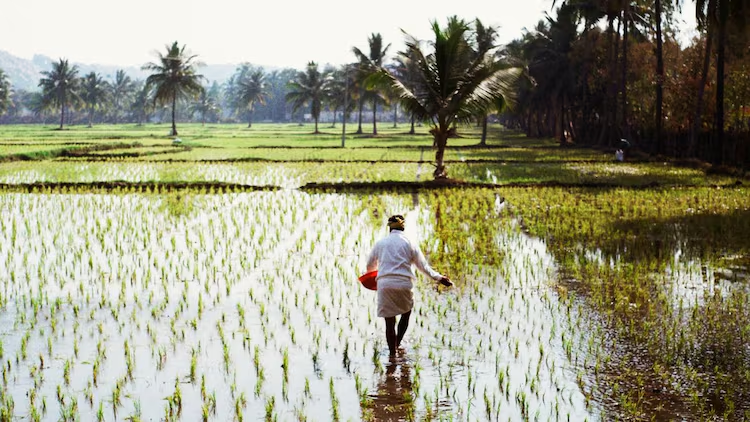
Short Overview
Imagine wheat and rice crops that no longer need urea fertilisers. A new scientific breakthrough shows that a tiny protein change could allow cereal crops to fix nitrogen directly from the air—just like legumes. This discovery could save India ₹40,000 crore every year, reduce pollution, protect groundwater, and spark a second Green Revolution.Nitrogen-fixing cereals could redefine Indian agriculture. Scientists have discovered that a small protein switch can enable wheat and rice to fix nitrogen naturally, like legumes. This breakthrough may save India ₹40,000 crore annually in urea subsidies, reduce greenhouse gas emissions, protect Punjab’s groundwater, and boost farmer incomes. Learn how this discovery works, its environmental impact, and why it could trigger India’s second Green Revolution.
Table of Contents
- Introduction: Why Nitrogen-Fixing Cereals Matter
- India’s Heavy Dependence on Urea
- How Plants Naturally Fix Nitrogen
- The Tiny Protein Flip That Changed Everything
- How Scientists Reprogrammed Cereal Crops
- Environmental Benefits of Nitrogen-Fixing Cereals
- Economic Impact: How Much India Could Save
- Impact on Punjab’s Groundwater Crisis
- Benefits for Small and Marginal Farmers
- Can This Trigger India’s Second Green Revolution?
- Regulatory Challenges and the Road Ahead
- Conclusion: A Small Change with a Big Future
1. Introduction: Why Nitrogen-Fixing Cereals Matter
Indian agriculture stands at a crossroads. For decades, higher crop yields have depended heavily on chemical fertilisers, especially urea. While this helped feed a growing population, it also created serious environmental and economic problems. A new scientific breakthrough now offers a cleaner and cheaper alternative—nitrogen-fixing cereals that could change how India grows food forever.

2. India’s Heavy Dependence on Urea
India is one of the world’s largest consumers of urea fertiliser. Wheat and rice, the backbone of India’s food system, require large nitrogen inputs to grow. To keep fertilisers affordable, the government spends lakhs of crores of rupees every year on subsidies.
This heavy urea use has led to soil degradation, polluted groundwater, rising greenhouse gas emissions, and a massive financial burden on the national budget.
3. How Plants Naturally Fix Nitrogen
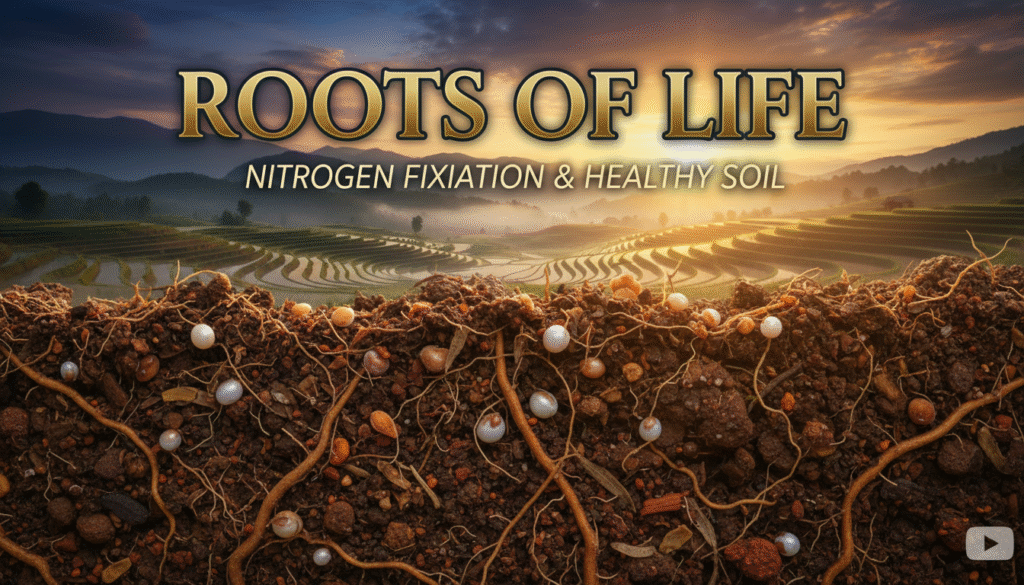
Nitrogen makes up nearly 78% of the air, yet plants cannot use it directly. Some plants, mainly legumes like peas and soybeans, solve this problem through a natural partnership with soil bacteria called rhizobia.
These bacteria live inside root nodules and convert atmospheric nitrogen into a usable form. In return, the plant provides food and shelter. This process is called biological nitrogen fixation, and it allows legumes to grow without chemical fertilisers.
4. The Tiny Protein Flip That Changed Everything
Scientists from Aarhus University, in a study published in Nature, discovered that the difference between legumes and cereals comes down to a tiny molecular switch.
This switch is controlled by just two amino acids in a protein receptor found in plant roots. In legumes, this receptor allows friendly bacteria to enter the roots. In cereals, the same receptor triggers an immune response that blocks bacteria.
5. How Scientists Reprogrammed Cereal Crops
By changing just two amino acids in the receptor protein, researchers managed to flip this switch. The modified cereal plants stopped rejecting nitrogen-fixing bacteria and started cooperating with them instead.
In experiments on barley, the plants formed root nodules similar to those seen in lentils. This proves that cereals already have the necessary machinery—they just needed a small adjustment.
6. Environmental Benefits of Nitrogen-Fixing Cereals
Chemical fertiliser production consumes about 2% of global energy and releases large amounts of carbon dioxide. Excess urea also releases nitrous oxide, a greenhouse gas nearly 300 times more potent than CO₂.
Nitrogen-fixing cereals could dramatically cut fertiliser use, reduce emissions, improve soil health, and lower water pollution. This would make Indian agriculture far more climate-friendly.
7. Economic Impact: How Much India Could Save
According to estimates from the Indian Council of Agricultural Research, if wheat and rice fix just 50 kg of nitrogen per hectare, India could save around ₹40,000 crore annually in fertiliser subsidies.
This money could be redirected toward irrigation, crop insurance, rural infrastructure, and agricultural research.
8. Impact on Punjab’s Groundwater Crisis
Punjab has suffered severe groundwater contamination due to decades of excessive urea use. Nitrates have seeped into drinking water, posing serious health risks.
Reducing urea application through nitrogen-fixing cereals could give Punjab immediate relief by slowing groundwater pollution and restoring soil balance.
9. Benefits for Small and Marginal Farmers
For farmers in drought-prone Bundelkhand or flood-affected Bihar, fertiliser timing often depends on unpredictable monsoons. Nitrogen-fixing cereals would reduce dependency on top-dressing urea, cut input costs, and offer more stable yields.
Lower costs mean higher profits and less debt for small farmers.

10. Can This Trigger India’s Second Green Revolution?
The first Green Revolution focused on high-yield varieties and chemical inputs. The next one could be based on biological innovation and sustainability.
Nitrogen-fixing cereals combine productivity with environmental protection, making them ideal for India’s future food security needs.
11. Regulatory Challenges and the Road Ahead
The biggest question now is speed. Gene-edited crops require clear and efficient regulatory approval. Since this breakthrough involves a tiny protein change rather than foreign DNA, faster approvals could be possible.
If adopted quickly, India could lead the world in sustainable cereal farming.
12. Conclusion: A Small Change with a Big Future
A two-amino-acid change may seem insignificant, but it could rewrite the future of Indian agriculture. Nitrogen-fixing cereals promise lower costs, cleaner soil and water, reduced emissions, and stronger farmer livelihoods.
If implemented wisely, this tiny protein flip could indeed trigger India’s second Green Revolution—one that feeds the nation without harming the planet.


India’s 2026 strategy for importing fertiliser: how India is making global supply chains stronger

The Effects of Global War on Farming in India: Why Prices Are Going Up and What Farmers Can Do

Digital Transformation in Agriculture: How Smart Technology is Changing the Way We Farm Today

The Truth About AI Stock Trading: An AI-Powered Trading Agent Turns ₹11 Lakh Into ₹40 Lakh Overnight

Organic Fertilizer Market Size and Forecast for 2026–2034: Trends in Growth, Future Demand, and Information on Sustainable Agriculture

Bharat-VISTAAR: India’s New AI Digital Platform Changing Farming for Millions of Farmers

Liberating Agriculture in Bharat: A Long-Term Future for Farmers Through Farming with Trees

FAO World Programme of Census of Agriculture 2030: A Global Data Revolution for the Future of Farming

India is running low on LPG in 2026, so hotels are switching to firewood as the government focuses on cooking gas for homes.

The economy of Karnataka is doing better than the national average. The state’s growth rate is 12% for the second year in a row.

What Is the Best Climate for Saffron Cultivation?
India is running low on LPG in 2026, so hotels are switching to firewood as the government focuses on cooking gas for homes.

Karnataka Budget 2026–27: Key Announcements, Infrastructure Plans, Welfare Schemes and Economic Impact

Farming: ಹಳ್ಳಿಗಳಿಗೆ ಹಿಂದಿರುಗಿ ಕೃಷಿಯತ್ತ ಒಲವು ತೋರುತ್ತಿರುವ ವೃತ್ತಿಪರರು – ನಿಜವಾದ ಕಾರಣಗಳು ಮತ್ತು ಭವಿಷ್ಯದ ಜೀವನಶೈಲಿ

ಕೇಂದ್ರ ಬಜೆಟ್ 2026 ಕೃಷಿಕರಿಗೆ ಏನು ಕೊಡುಗೆ? ಭಾರತ್ ವಿಸ್ತಾರ್ AI ಪರಿಕರದಿಂದ ರೈತರಿಗೇನು ಲಾಭ?

Aadhar Model Smart Card To Farmers: ರೈತರಿಗೆ ಆಧಾರ್ ಮಾದರಿ ಸ್ಮಾರ್ಟ್ ಕಾರ್ಡ್ ಯೋಜನೆ – ಸಂಪೂರ್ಣ ಮಾಹಿತಿ, ಅನುಕೂಲತೆಗಳು ಮತ್ತು ನೋಂದಣಿ ವಿವರಗಳು

ಭಾರತ್-ವಿಸ್ತಾರ್ ಎಐ ಸಾಧನ: ರೈತರ ಕೃಷಿ ಸಮಸ್ಯೆಗೆ ಬೆರಳ ತುದಿಯಲ್ಲಿ ಎಐ ಪರಿಹಾರ | ಸಂಪೂರ್ಣ ಮಾಹಿತಿ

Sugar Shares Rally on Hopes of Higher Ethanol Blend Amid West Asia Crisis
FAO World Programme of Census of Agriculture 2030: A Global Data Revolution for the Future of Farming
